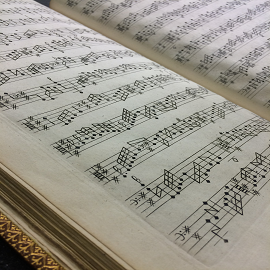
Item 018 - Summer is Nigh : Part-Song

Open original Digital object

Title and statement of responsibility area

Title proper

Summer is Nigh : Part-Song

General material designation

    Parallel title

    Other title information

    Title statements of responsibility

    Title notes

    Level of description

    Item

    Reference code

    CA MDML 013-1-018

    Edition area

    Edition statement

    Edition statement of responsibility

    Class of material specific details area

    Statement of scale (cartographic)

    Statement of projection (cartographic)

    Statement of coordinates (cartographic)

    Statement of scale (architectural)

    Issuing jurisdiction and denomination (philatelic)

    Dates of creation area

    Date(s)

    Physical description area

    Physical description

    4 pages

    Publisher's series area

    Title proper of publisher's series

    The Musical Times

    Parallel titles of publisher's series

    Other title information of publisher's series

    Statement of responsibility relating to publisher's series

    Numbering within publisher's series

    No. 439

    Note on publisher's series

    Archival description area

    Name of creator

    (1804-1885)

    Biographical history

    Conductor and composer Sir Julius Benedict was born in Stuttgart, the son of a wealthy banker. He learnt composition in Weimar and Dresden and was appointed Kapellmeister of the Kärnthnerthor theatre at Vienna in 1823. Two years later he became Kapellmeister of the San Carlo theatre at Naples where he produced his first two operas. In 1834 he went to Paris, leaving the next year for London, where he spent the remainder of his life.

    Benedict was given the conductorship of an operatic enterprise at the Lyceum Theatre in 1836 and he brought out a short opera previously given in Naples. He became conductor of the English opera at Theatre Royal, Drury Lane and produced several of his own operas and conducted Felix Mendelssohn's Elijah at Exeter Hall, for the first appearance of Jenny Lind in oratorio. In 1850 he was the accompanist and conductor on Lind's tour of America. On his return he became musical conductor at Her Majesty's Theatre (and afterwards at Drury Lane), and conductor of the Harmonic Union. His best-known opera, The Lily of Killarney, was produced at Covent Garden and his operetta The Bride of Song was introduced there.

    Benedict wrote a march for the wedding of Albert Edward, Prince of Wales and Alexandra of Denmark in 1863. Graziella, a cantata, was given at the Birmingham Festival of 1882, and was later produced in operatic form at the Crystal Palace.

    Benedict conducted every Norwich Festival from 1845 to 1878 inclusive, and the Liverpool Philharmonic Society's concerts from late 1875 to 1880. He was the regular accompanist at the Monday Popular Concerts in London from their start, and acted as conductor of these concerts. In 1871 he was knighted, and in 1874 was made knight commander of the orders of Franz Joseph I of Austria and Frederick I of Württemberg. In 1884, friends set up a benefit fund to aid him financially. He died in London on 5 June 1885.

    A selective list of his orchestral works includes 13 works, 7 choral and vocal works, 8 operatic works and 5 other compositions.

    Custodial history

    Scope and content

    Notes area

    Physical condition

    Immediate source of acquisition

    Arrangement

    Language of material

      Script of material

        Location of originals

        Availability of other formats

        Restrictions on access

        Terms governing use, reproduction, and publication

        Finding aids

        Associated materials

        Related materials

        Accruals

        General note

        S.A.T.B. and piano

        General note

        Sold by De Zouche , Co., Pianos and Music, Montreal

        General note

        Performed on 12 January 1883

        Alternative identifier(s)

        Annotated number

        No. 65

        Standard number

        Standard number

        Access points

        Subject access points

        Place access points

        Name access points

        Genre access points

        Control area

        Description record identifier

        Institution identifier

        Rules or conventions

        Status

        Level of detail

        Dates of creation, revision and deletion

        Language of description

          Script of description

            Sources

            Digital object (External URI) rights area

            Digital object (Reference) rights area

            Digital object (Thumbnail) rights area

            Accession area