Master plans (orthographic projections),

Elements area

Taxonomy

Code

300076275

Scope note(s)

    Source note(s)

    • AAT

    Display note(s)

      Hierarchical terms

      Master plans (orthographic projections),

        Equivalent terms

        Master plans (orthographic projections),

          Associated terms

          Master plans (orthographic projections),

            9 Archival description results for Master plans (orthographic projections),

            CA CAC 58-1-10004 · Subseries · between 1974 and 1988
            Part of Moshe Safdie

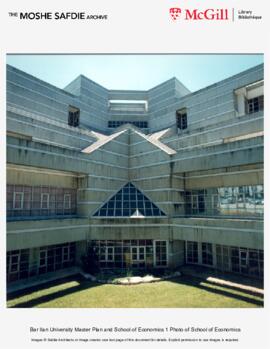
            The new Bar Ilan University master plan that Moshe Safdie designed was for the School of Economics and the Student Dormitories. It was planned as an urban system composed of open quadrangles defined by buildings and urban thorough fares which branched out to secondary roads and other squares. The School of Economics is an 8-storey multi-purpose building that is terraced, providing shade for the main campus walkway by its overhangs. The Student Dormitories, accommodating about 200 students, consist of a 2-storey living area around which the bedrooms are clustered. Overall, the dorms reach 6 storeys in height, stacking three terraced apartment units together, with the public spaces facing the academic quadrangle and the private spaces facing the south.

            Safdie Architects
            CA CAC 58-1-286 · Subseries · 1979
            Part of Moshe Safdie

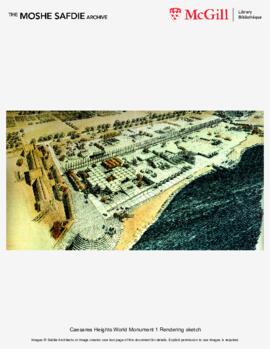
            The Caesarea World Monument involved building a World Study Center with the development of a master plan to restore and reconstruct the ancient city of Caesarea Maritima on the Sea. The entire project was divided into six phases, and Safdie's involvement was limited to the first two phases: the restoration of the Cardo Maximus, a 0.4 km pedestrian walkway extending from the amphitheatre to the moat of the Crusader Fortress; and the construction of the World Study Center Building, providing facilities for archaeological research and study, as well as for preservation and display of excavated material.

            Safdie Architects
            Cité des Iles
            CA CAC 58-1-112 · Subseries · 1968
            Part of Moshe Safdie

            Cité des Iles was a study proposed to the City of Montreal by Moshe Safdie following the close of Expo '67. The overall idea behind the study was to transform the temporary Expo exhibition site including structures, parks, and transit lines into permanent amenities for the city. The study was well received by many city officials, but did not proceed because of anticipated review complications between the various levels of provincial, federal, and municipal agencies.

            Safdie Architects
            CA CAC 58-1-98 · Subseries · 1962
            Part of Moshe Safdie

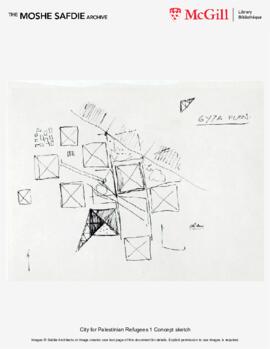
            The city of Giza was a theoretical study for a high-density city, amidst the existing ancient pyramids, which could accommodate the resettlement of 250,000 Palestinian refugees. Giza illustrated a number of concepts which Moshe Safdie had been exploring prior to Habitat '67 such as workable high-density environments, three-dimensional reorganization of urban land uses, the organization of individual dwellings as spatial groupings, the hierarchical organization of transportation networks, and the utilization of mass-production construction techniques.

            Safdie Architects
            Coldspring New Town
            CA CAC 58-1-167 · Subseries · between 1972 and 1981
            Part of Moshe Safdie

            Moshe Safdie developed a three-dimensional master plan for the newly proposed residential community of Coldspring. The master plan included a town center with retail and office space, two neighbourhood centers, three schools, over 3,000 dwelling units, three lakes, and an ecology center. Due to the topography of the site, three types of housing were designed: high rises, hillside clusters, and deck houses. The underlying concept of the deck house was to stack the community and residential spaces above the parking, enabling a higher building density to be achieved and therefore devoting more land to private or communal outdoor uses.

            Safdie Architects
            CA CAC 28-47 · File · 1979
            Part of John Schreiber Fonds

            File contains preliminary drawings, prints, and photographic prints for a proposed multi-family residential project in Trois Rivières, Quebec, designed for a competition organized by Central Mortgage and Housing Corporation (CMHC). The project received a special mention award.

            Simpang New Town
            CA CAC 58-1-514 · Subseries · between 1992 and 1994
            Part of Moshe Safdie

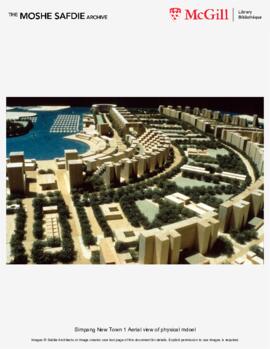
            In this proposed new town of 125,000, commissioned by the Housing and Development Board of the Republic of Singapore, the repetitive housing typology model that maximizes density is re-examined. To break down the scale and maintain target densities, several housing typologies combine to create a hierarchy of massing that maximizes views and daylight exposures.

            These planning precepts incorporate a combination of high- and medium-density walk-ups with high-rise buildings, including terraced housing and clusters, to form urban windows that prevent the formation of solid walls along waterfront and park edges.

            Three principal main streets and a central linear park unite and orient the town. Streets and pedestrian paths run perpendicular to the park, where most social and educational services are located, bringing all dwellings into close walking and driving proximity to greenery, services, the town center, and the sea front. To capture views and take advantage of the city's natural edges, high-rise towers line the central park, the southern edge of town, and the waterfront. These design principles create a new and vibrant urbanism, celebrating the connection to the natural world with an organized set of networks and systems that serve diverse community activities and needs. Completed in 1994.

            Safdie Architects