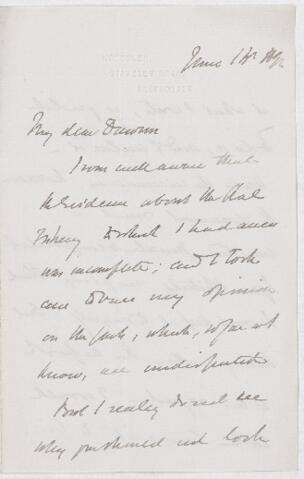
Item 0058 - Letter, 14 June 1892

Open original Digital object

Title and statement of responsibility area

Title proper

Letter, 14 June 1892

General material designation

    Parallel title

    Other title information

    Title statements of responsibility

    Title notes

    • Source of title proper: Title based on content.

    Level of description

    Item

    Reference code

    CA MUA MG 1022-6-087-0058

    Edition area

    Edition statement

    Edition statement of responsibility

    Class of material specific details area

    Statement of scale (cartographic)

    Statement of projection (cartographic)

    Statement of coordinates (cartographic)

    Statement of scale (architectural)

    Issuing jurisdiction and denomination (philatelic)

    Dates of creation area

    Date(s)

    • 14 June 1892 (Creation)
      Creator
      Huxley, Thomas Henry, 1825-1895
      Place
      Eastbourne (East Sussex, England)

    Physical description area

    Physical description

    Publisher's series area

    Title proper of publisher's series

    Parallel titles of publisher's series

    Other title information of publisher's series

    Statement of responsibility relating to publisher's series

    Numbering within publisher's series

    Note on publisher's series

    Archival description area

    Name of creator

    (1825-1895)

    Biographical history

    Thomas Henry Huxley was born on May 4, 1825, in Ealing, Middlesex, England.

    He was an English biologist, anthropologist, educator, and advocate of agnosticism. Despite his lack of early formal education, he studied mechanical engineering and science, and read books on many subjects. His self-taught study of German enabled his future proficiency in the biological research conducted in Germany, and a talent for drawing aided his later zoological studies. In 1841, he apprenticed with his brother-in-law, a physician John Godwin Scott in London. He continued his self-education and in 1842, he received a scholarship to Charing Cross Hospital and published his first scientific paper in 1845. With mounting debts, he never finished his studies and applied to the Royal Navy where he was made Assistant Surgeon to HMS Rattlesnake on a voyage of discovery and surveying to New Guinea and Australia. The Royal Society published several of his papers in its Philosophical Transactions. Upon his return to England in 1850, he was elected a Fellow of the Royal Society and in 1851, he not only received its medal but was elected to its Council. In 1854, he became Professor of Natural History at the Royal School of Mines and naturalist to the British Geological Survey in 1855. He was Fullerian Professor at the Royal Institution (1855–1858; 1865–1867); Hunterian Professor at the Royal College of Surgeons (1863–1869); President of the British Association for the Advancement of Science (1869–1870); President of the Quekett Microscopical Club (1878); President of the Royal Society (1883–1885); Inspector of Fisheries (1881–1885); and President of the Marine Biological Association (1884–1890). He was elected a member of the American Philosophical Society in 1869. In recognition of his many public services, he was given a pension by the state and was appointed Privy Councillor in 1892. He was also known for his support of Charles Darwin's theories.

    In 1855, he married Henrietta Anne Heathorn (1826–1914). He died on June 29, 1895, in Eastbourne, Sussex, England.

    Custodial history

    Scope and content

    Letter from T.H. Huxley to George Mercer Dawson, written from Eastbourne.

    Notes area

    Physical condition

    Immediate source of acquisition

    Arrangement

    Language of material

      Script of material

        Location of originals

        Availability of other formats

        Restrictions on access

        Terms governing use, reproduction, and publication

        Finding aids

        Associated materials

        Related materials

        Accruals

        Alternative identifier(s)

        Standard number

        Standard number

        Access points

        Subject access points

        Place access points

        Name access points

        Genre access points

        Control area

        Description record identifier

        Institution identifier

        Rules or conventions

        Status

        Level of detail

        Dates of creation, revision and deletion

        Language of description

          Script of description

            Sources

            Digital object (External URI) rights area

            Digital object (Reference) rights area

            Digital object (Thumbnail) rights area

            Accession area