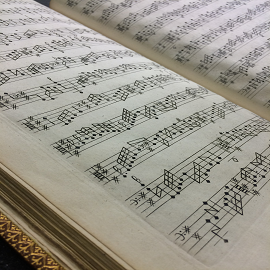
Item 141 - Hallelujah Chorus : from Engredi

Title and statement of responsibility area

Title proper

Hallelujah Chorus : from Engredi

General material designation

    Parallel title

    Other title information

    Title statements of responsibility

    Title notes

    Level of description

    Item

    Reference code

    CA MDML 013-1-141

    Edition area

    Edition statement

    Edition statement of responsibility

    Class of material specific details area

    Statement of scale (cartographic)

    Statement of projection (cartographic)

    Statement of coordinates (cartographic)

    Statement of scale (architectural)

    Issuing jurisdiction and denomination (philatelic)

    Dates of creation area

    Date(s)

    Physical description area

    Physical description

    11 pages

    Publisher's series area

    Title proper of publisher's series

    Novello's Octavo Choruses

    Parallel titles of publisher's series

    Other title information of publisher's series

    Statement of responsibility relating to publisher's series

    Numbering within publisher's series

    No. 196

    Note on publisher's series

    Archival description area

    Name of creator

    (1770-1827)

    Biographical history

    German composer and pianist Beethoven is widely considered to be one of the world’s greatest musical geniuses of all time. His music ranks amongst the most performed of the classical repertoire and he remains one of the most admired composers in the history of Western music. His innovative compositions combine vocals and instruments, widening the scope of sonata, symphony, concerto and quartet. He is the crucial transitional figure connecting the Classical and Romantic ages of Western music.
    Beethoven’s work is divided into early, middle, and late periods. In the early period he forged his craft. His middle period, sometimes characterized as heroic, shows an individual development from the "classical" styles of Hayden and Mozart. During that period, despite becoming increasingly deaf, he composed an opera, six symphonies, four solo concerti, five string quartets, six-string sonatas, seven piano sonatas, five sets of piano variations, four overtures, four trios, two sextets and 72 songs. In terms of the astonishing output of superlatively complex, original and beautiful music, this period in Beethoven's life is unrivaled by any of any other composer in history.
    In his late period he extended his innovations in musical form and expression. His Ninth Symphony, one of the first examples of a choral symphony was written in his last years, and his late string quartets of 1825–26 are amongst his final achievements.
    Beethoven raised instrumental music to the highest plane of art. His most notable innovation in the symphony and quartet is the replacement of the minuet by the more dynamic scherzo; he enriched both the orchestra and the quartet with a new range of sonority and variety of texture, and their forms are often greatly expanded. With the concerto, his formal innovations were equally influential, as with the entry of a solo instrument before an orchestral ritornello in the Fourth and Fifth piano concerti.
    After some months of bedridden illness Beethoven died in 1827.

    Custodial history

    Scope and content

    Notes area

    Physical condition

    Immediate source of acquisition

    Arrangement

    Language of material

      Script of material

        Location of originals

        Availability of other formats

        Restrictions on access

        Terms governing use, reproduction, and publication

        Finding aids

        Associated materials

        Related materials

        Accruals

        General note

        S.A.T.B. and organ or piano

        General note

        Sold by Jordens & Martins, 758 Broadway, N.Y.; C.C. De Zouche, Music Publisher, Montreal

        Alternative identifier(s)

        Annotated number

        No. 137

        Standard number

        Standard number

        Access points

        Subject access points

        Place access points

        Name access points

        Genre access points

        Control area

        Description record identifier

        Institution identifier

        Rules or conventions

        Status

        Level of detail

        Dates of creation, revision and deletion

        Language of description

          Script of description

            Sources

            Accession area