
McGill Libraries
McLennan Library Building3459 rue McTavish
Montreal, Quebec
H3A 0C9

1 page
Grace Linzee Revere, born to descendants of French Huguenots in Boston, was the great granddaughter of American hero Paul Revere. Early learned lessons of sympathy and charitable concern to help others, as well as practical skills in housekeeping, hosting and entertaining were to serve her well in her future life married to first one doctor then another. Her first husband, whom she married in 1876 was Dr. Samuel W. Gross, son of an eminent Philadelphia surgeon; he was 17 years older than she. Dr. Gross was instrumental in persuading Dr. William Osler to leave Montreal for Philadelphia where he taught four years at the University of Pennsylvania. Osler became a friend and frequent guest of the Grosses and was one of three attending physicians when in 1889 Dr. Gross died suddenly of pneumonia; on his deathbed he extracted a promise from them to look after Grace. Osler headed for Johns Hopkins in Baltimore that same year having accepted an appointment there with plans to work on a textbook, but he continued to visit Grace for the next few years. The day the textbook “Medicine” was published, “Willie,” as she called him, proposed and they were married rather secretly in 1892. In 1893, a son was born but died shortly after birth, but in 1895, another son, Edward Revere, was born and survived. When “Revere,” as he was known, was nine, Osler, at Grace’s urging, accepted an offer to become Regius professor of medicine at Oxford University, and the family moved to England.
Oxford is where Grace came into her own. There was a continual stream of distinguished scientists, friends, and students (including American Rhodes scholars) to their home at no. 13 Norham Gardens, known as the “Open Arms.” She would frequently host 30 for tea and was renowned for her hospitality, as well as charm, dignity, and sense of humor. In 1911 Osler became Sir William and she became Lady Grace Osler. Not long after war broke out; Grace devoted enormous energy into helping refugees, working with the wounded, but the family was devastated when Revere was fatally wounded in Flanders at the Battle of Passchendaele in 1917. Sir William died two years later. Grace spent her closing years overseeing the cataloguing of Osler’s library and preparing it to be shipped to McGill University in Montreal. She was often impatient with the perfectionism of W.W. Francis, who was preparing the Bibliotheca Osleriana, which became influential in medical history and the development of medical bibliography. She died in 1928 soon after the boxes arrived to be loaded with Sir William’s books. The ashes of Sir William and Lady Grace are in McGill’s Osler Library.
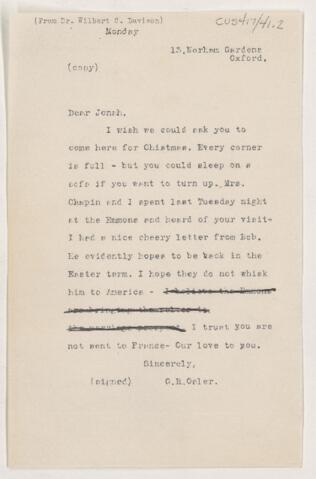
Letter to Wilburt Cornell Davison from Grace Revere Osler, 13, Norham Gardens, Oxford, Oxfordshire, England. Lady Osler invites Davison to spend Christmas in Oxford. She writes of the Emmons.
Fragile.
Copy or transcription.
Cushing's colour code: White (Correspondence)