Item 0009 - Letter, 6 September 1883

Open original Digital object

Title and statement of responsibility area

Title proper

Letter, 6 September 1883

General material designation

    Parallel title

    Other title information

    Title statements of responsibility

    Title notes

    • Source of title proper: Title based on content.

    Level of description

    Item

    Reference code

    CA MUA MG 1022-2-1-193-0009

    Edition area

    Edition statement

    Edition statement of responsibility

    Class of material specific details area

    Statement of scale (cartographic)

    Statement of projection (cartographic)

    Statement of coordinates (cartographic)

    Statement of scale (architectural)

    Issuing jurisdiction and denomination (philatelic)

    Dates of creation area

    Date(s)

    • 6 September 1883 (Creation)
      Creator
      Carnarvon, Henry Howard Molyneux, Earl of, 1831-1890

    Physical description area

    Physical description

    Publisher's series area

    Title proper of publisher's series

    Parallel titles of publisher's series

    Other title information of publisher's series

    Statement of responsibility relating to publisher's series

    Numbering within publisher's series

    Note on publisher's series

    Archival description area

    Name of creator

    (1831-1890)

    Biographical history

    Henry Howard Molyneux Herbert, 4th Earl of Carnarvon, known as Lord Porchester (1833-1849), was born on June 24, 1831, in London, England.

    He was a British politician and a leading member of the Conservative Party. He was twice Secretary of State for the Colonies and served as Lord Lieutenant of Ireland. He was educated at Eton College. In 1849, he succeeded his father in the earldom. He started his political career with a speech in the House of Lords in 1854. In 1863, he worked on penal reform and many of his ideas were implemented in the Prisons Act 1866. In 1866, he was sworn of the Privy Council and appointed Secretary of State for the Colonies. In 1867, he introduced the British North America Act, which conferred self-government on Canada, and created a federation. In 1874, he returned to the office of the British colonial secretary where he settled various disputes within the colonies. From 1885 to 1886, he served as Lord Lieutenant of Ireland. He was regarded as a highly cultured man and was a president and a fellow of the Society of Antiquaries and a Fellow of the Royal Society as well as high steward of Oxford University.

    In 1861, he married Lady Evelyn Stanhope (1834–1875). In 1878, he married Elizabeth Catherine Howard (1856–1929). He died on June 29, 1890, in London, England.

    Custodial history

    Scope and content

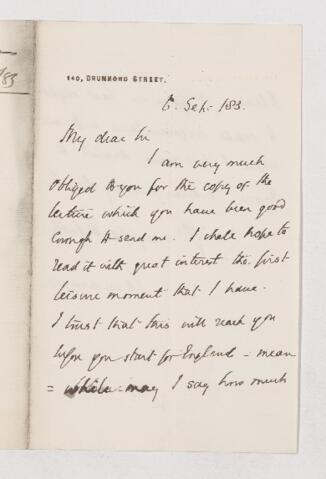
    Letter from Camawon? to John William Dawson.

    Notes area

    Physical condition

    Immediate source of acquisition

    Arrangement

    Language of material

      Script of material

        Location of originals

        Availability of other formats

        Restrictions on access

        Terms governing use, reproduction, and publication

        Finding aids

        Associated materials

        Related materials

        Accruals

        Alternative identifier(s)

        Standard number

        Standard number

        Access points

        Subject access points

        Place access points

        Name access points

        Genre access points

        Control area

        Description record identifier

        Institution identifier

        Rules or conventions

        Status

        Level of detail

        Dates of creation, revision and deletion

        Language of description

          Script of description

            Sources

            Digital object (External URI) rights area

            Digital object (Reference) rights area

            Digital object (Thumbnail) rights area

            Accession area