Item 0009 - Letter, 4 March 1882

Open original Digital object

Title and statement of responsibility area

Title proper

Letter, 4 March 1882

General material designation

    Parallel title

    Other title information

    Title statements of responsibility

    Title notes

    • Source of title proper: Title based on content.

    Level of description

    Item

    Reference code

    CA MUA MG 1022-2-1-175-0009

    Edition area

    Edition statement

    Edition statement of responsibility

    Class of material specific details area

    Statement of scale (cartographic)

    Statement of projection (cartographic)

    Statement of coordinates (cartographic)

    Statement of scale (architectural)

    Issuing jurisdiction and denomination (philatelic)

    Dates of creation area

    Date(s)

    • 4 March 1882 (Creation)
      Creator
      Scudder, Samuel Hubbard, 1837-1911
      Place
      Cambridge (Mass.)

    Physical description area

    Physical description

    Publisher's series area

    Title proper of publisher's series

    Parallel titles of publisher's series

    Other title information of publisher's series

    Statement of responsibility relating to publisher's series

    Numbering within publisher's series

    Note on publisher's series

    Archival description area

    Name of creator

    (1837-1911)

    Biographical history

    Samuel Hubbard Scudder was an American entomologist and palaeontologist, considered the founder of insect palaeontology. He came from a Congregationalist family with roots going back to Massachusetts Bay Colony Puritans. Educated at Boston Latin School, he graduated from Williams College in 1847 at the head of his class. He later earned a second bachelor's degree studying with the famous naturalist Louis Agassiz at Harvard. A prolific author of some 791 papers between 1858 and 1902, he contributed an addendum to George Mercer Dawson's Progress Report of the Canadian Geological Survey, 1875-76, on the rare extinct fossil species of ant, Aphaenogaster longaeva; the fossil was discovered in shale that Dawson had surveyed near Quesnel, B.C. Scudder also had contacts with Dawson through his work as staff palaeontologist for the US Geological Survey (1886-1892). Other palaeontological works included Index of Fossil Insects of the World (1891), but he also authored many works on present-day insects, notably Lepidoptera (butterflies and moths) including the monumental Butterflies of the Eastern United States and Canada, and some 180 papers on Orthoptera (grasshoppers), describing 630 species in 106 genera.
    As well as his extensive research, he filled many roles at scientific societies of the time, including as president of the Boston Society of Natural History (1880-1887) and as librarian for the American Academy of Arts and Sciences.
    His son Gardner accompanied him on many field trips until contracting tuberculosis and dying in 1902. Scudder himself developed Parkinson's that same year, necessitating his retirement and leading to his death in 1911.

    Custodial history

    Scope and content

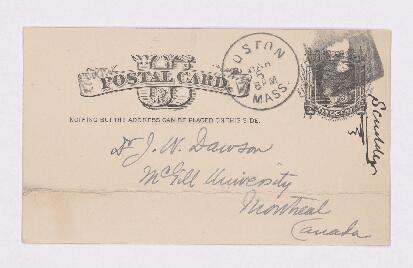
    Letter from S.H. Scudder to John William Dawson, written from Cambridge, Massachusetts.

    Notes area

    Physical condition

    Immediate source of acquisition

    Arrangement

    Language of material

      Script of material

        Location of originals

        Availability of other formats

        Restrictions on access

        Terms governing use, reproduction, and publication

        Finding aids

        Associated materials

        Related materials

        Accruals

        Alternative identifier(s)

        Standard number

        Standard number

        Access points

        Subject access points

        Place access points

        Name access points

        Genre access points

        Control area

        Description record identifier

        Institution identifier

        Rules or conventions

        Status

        Level of detail

        Dates of creation, revision and deletion

        Language of description

          Script of description

            Sources

            Digital object (External URI) rights area

            Digital object (Reference) rights area

            Digital object (Thumbnail) rights area

            Accession area