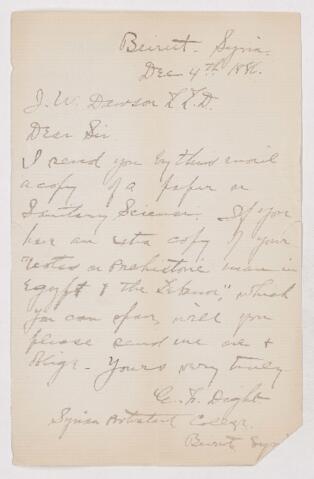
Item 0001 - Letter, 4 December 1886

Open original Digital object

Title and statement of responsibility area

Title proper

Letter, 4 December 1886

General material designation

    Parallel title

    Other title information

    Title statements of responsibility

    Title notes

    • Source of title proper: Title based on content.

    Level of description

    Item

    Reference code

    CA MUA MG 1022-2-1-226-0001

    Edition area

    Edition statement

    Edition statement of responsibility

    Class of material specific details area

    Statement of scale (cartographic)

    Statement of projection (cartographic)

    Statement of coordinates (cartographic)

    Statement of scale (architectural)

    Issuing jurisdiction and denomination (philatelic)

    Dates of creation area

    Date(s)

    • 4 December 1886 (Creation)
      Creator
      Dight, Charles Fremont, 1856-1938
      Place
      Beirut (Lebanon)

    Physical description area

    Physical description

    Publisher's series area

    Title proper of publisher's series

    Parallel titles of publisher's series

    Other title information of publisher's series

    Statement of responsibility relating to publisher's series

    Numbering within publisher's series

    Note on publisher's series

    Archival description area

    Name of creator

    (1856-1938)

    Biographical history

    Charles Fremont Dight was born in July 1856, in Mercer, Pennsylvania.

    He was a physician, professor, and promoter of the human eugenics movement in Minnesota. He graduated with a medical degree from the University of Michigan in 1879. From 1883 to 1889 he was a professor of anatomy and physiology at the American University of Beirut, Syria (now Lebanon). From about 1890 to 1892 Dight served as resident physician and teacher of physiology and hygiene at Shattuck School, Faribault, Minnesota and later at Hamline University which became part of the University of Minnesota in 1907. He was also a professor at the medical school of New Orleans University. From 1914 to 1918, he served as an alderman from the 12th district of Minneapolis and was instrumental in passing an ordinance requiring the pasteurization of milk. Dight became a proponent of eugenics during the 1920s. He founded the Minnesota Eugenics Society in 1923 and persuaded the Minnesota legislature to pass a sterilization law in 1925. He actively pursued the same type of eugenics as Nazi medicine. In 1933, Dight wrote a letter to Adolf Hitler praising his efforts to "stamp out mental inferiority." He was the author of "History of the Early Stages of the Organized Eugenics Movement in Minnesota for Human Betterment" (1935), and "Call for a New Social Order" (1936).

    In 1892, he married Mary Alice Glidden Crawford (1860–1923) and divorced in 1899. He died on June 20, 1938, in Minneapolis, Minnesota.

    Custodial history

    Scope and content

    Letter from E.F. Dight to John William Dawson, written from Beirut, Syria.

    Notes area

    Physical condition

    Immediate source of acquisition

    Arrangement

    Language of material

      Script of material

        Location of originals

        Availability of other formats

        Restrictions on access

        Terms governing use, reproduction, and publication

        Finding aids

        Associated materials

        Related materials

        Accruals

        Alternative identifier(s)

        Standard number

        Standard number

        Access points

        Subject access points

        Place access points

        Name access points

        Genre access points

        Control area

        Description record identifier

        Institution identifier

        Rules or conventions

        Status

        Level of detail

        Dates of creation, revision and deletion

        Language of description

          Script of description

            Sources

            Digital object (External URI) rights area

            Digital object (Reference) rights area

            Digital object (Thumbnail) rights area

            Accession area