Item 0004 - Letter, 4 April 1870

Open original Digital object

Title and statement of responsibility area

Title proper

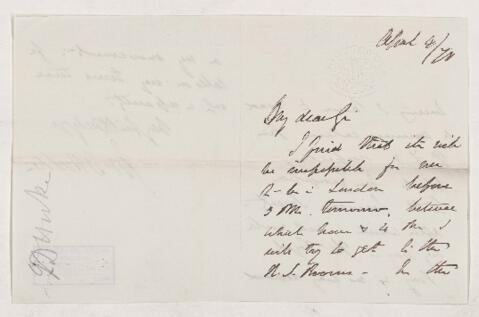
Letter, 4 April 1870

General material designation

    Parallel title

    Other title information

    Title statements of responsibility

    Title notes

    • Source of title proper: Title based on content.

    Level of description

    Item

    Reference code

    CA MUA MG 1022-2-1-052-0004

    Edition area

    Edition statement

    Edition statement of responsibility

    Class of material specific details area

    Statement of scale (cartographic)

    Statement of projection (cartographic)

    Statement of coordinates (cartographic)

    Statement of scale (architectural)

    Issuing jurisdiction and denomination (philatelic)

    Dates of creation area

    Date(s)

    • 4 April 1870 (Creation)
      Creator
      Hooker, Joseph Dalton, 1817-1911

    Physical description area

    Physical description

    Publisher's series area

    Title proper of publisher's series

    Parallel titles of publisher's series

    Other title information of publisher's series

    Statement of responsibility relating to publisher's series

    Numbering within publisher's series

    Note on publisher's series

    Archival description area

    Name of creator

    (1817-1911)

    Biographical history

    Sir Joseph Dalton Hooker was born on June 30, 1817, in Halesworth, Suffolk, England, the second son of the distinguished botanist, Sir William Jackson Hooker (1785-1865).

    He was a British botanist, explorer, and supporter of Darwin’s theories. At 15 he began to attend classes at the University of Glasgow, at first in classics and mathematics and later in medicine (M.D., 1839). Having a wide knowledge of botany based on work in his father's herbarium and on extensive plant-collecting in the British Isles, his degree enabled him to join the Naval Medical Service and to accompany a scientific expedition to the Antarctic (1839-1843). He became assistant director of the Royal Botanic Gardens at Kew (1855-1865). In 1865, he succeeded his father as director, serving in that capacity until his retirement in 1885. His last major botanical expedition to the Rocky Mountains and California (1877), led to the publication of several important papers concerning the relationship of American and Asian floras. His travels resulted in the discovery of species new to science, many of which were soon introduced to horticultural circles. He gained an international reputation as a pioneer plant geographer. He was elected a fellow of the Linnean Society in 1842 and of the Royal Society in 1847. He also served as president of the Royal Society (1873–1878) and was knighted in 1877.

    In 1851, he married Frances Harriet Henslow (1825–1874) and in 1877, he married Hyacinth Symonds (1842–1921). He died on December 10, 1911, in Sunningdale, Berkshire, England.

    Custodial history

    Scope and content

    Letter from J.D. Hooker to John William Dawson.

    Notes area

    Physical condition

    Immediate source of acquisition

    Arrangement

    Language of material

      Script of material

        Location of originals

        Availability of other formats

        Restrictions on access

        Terms governing use, reproduction, and publication

        Finding aids

        Associated materials

        Related materials

        Accruals

        Alternative identifier(s)

        Standard number

        Standard number

        Access points

        Subject access points

        Place access points

        Name access points

        Genre access points

        Control area

        Description record identifier

        Institution identifier

        Rules or conventions

        Status

        Level of detail

        Dates of creation, revision and deletion

        Language of description

          Script of description

            Sources

            Digital object (External URI) rights area

            Digital object (Reference) rights area

            Digital object (Thumbnail) rights area

            Accession area