Item 0018 - Letter, 29 September 1883

Open original Digital object

Title and statement of responsibility area

Title proper

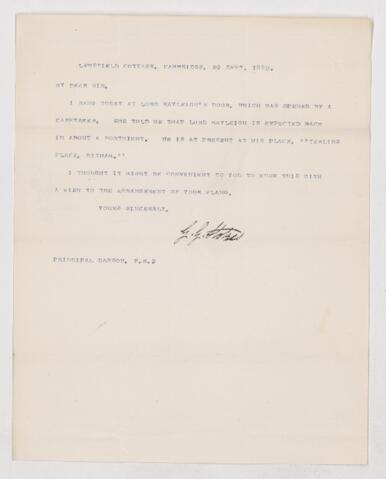
Letter, 29 September 1883

General material designation

    Parallel title

    Other title information

    Title statements of responsibility

    Title notes

    • Source of title proper: Title based on content.

    Level of description

    Item

    Reference code

    CA MUA MG 1022-2-1-193-0018

    Edition area

    Edition statement

    Edition statement of responsibility

    Class of material specific details area

    Statement of scale (cartographic)

    Statement of projection (cartographic)

    Statement of coordinates (cartographic)

    Statement of scale (architectural)

    Issuing jurisdiction and denomination (philatelic)

    Dates of creation area

    Date(s)

    • 29 September 1883 (Creation)
      Creator
      Stokes, George Gabriel, 1819-1903
      Place
      Cambridge (England)

    Physical description area

    Physical description

    Publisher's series area

    Title proper of publisher's series

    Parallel titles of publisher's series

    Other title information of publisher's series

    Statement of responsibility relating to publisher's series

    Numbering within publisher's series

    Note on publisher's series

    Archival description area

    Name of creator

    (1819-1903)

    Biographical history

    Sir George Gabriel Stokes, the 1st Baronet, was born on August 13, 1819, in Skreen, County Sligo, Ireland.

    He was a physicist and mathematician. In 1837, he graduated from Pembroke College, Cambridge, and in 1841, he was elected its fellow. His marriage prevented him from continuing at Pembroke because of a rule barring married fellows. The rule was later revoked, and twelve years later, Stokes's fellowship was reinstated. In 1849, he was appointed the Lucasian Professor of Mathematics at Cambridge, a position he held until his death in 1903. He lectured on hydrostatics, physical optics (polarization and fluorescence), and fluid dynamics (including the Navier–Stokes equations). He was elected a Secretary for the Royal Society in 1854. He represented Cambridge University in the British House of Commons from 1887 to 1892, sitting as a Conservative. Stokes also served as president of the British Association for the Advancement of Science (1869) and the Royal Society (1885-1890). In 1852, he won the Royal Society's Rumford Medal and, in 1893, Copley Medal. In 1886, Stokes, a religious man throughout his life, was appointed president of the Victoria Institute, which explored the relationship between religious doctrine and the findings of science. He sided with other scientists in their critical view of Charles Darwin's theory of evolution. In 1889, Queen Victoria created him the Baronet. Stokes published numerous treatises on mathematical, philosophical, and scientific subjects.

    In 1857, he married Mary Susanna Robinson (1825–1899). He died on February 1, 1903, in Cambridge, Cambridgeshire, England.

    Custodial history

    Scope and content

    Letter from G.G. Stokes to John William Dawson, written from Cambridge, England E.

    Notes area

    Physical condition

    Immediate source of acquisition

    Arrangement

    Language of material

      Script of material

        Location of originals

        Availability of other formats

        Restrictions on access

        Terms governing use, reproduction, and publication

        Finding aids

        Associated materials

        Related materials

        Accruals

        Alternative identifier(s)

        Standard number

        Standard number

        Access points

        Subject access points

        Place access points

        Name access points

        Genre access points

        Control area

        Description record identifier

        Institution identifier

        Rules or conventions

        Status

        Level of detail

        Dates of creation, revision and deletion

        Language of description

          Script of description

            Sources

            Digital object (External URI) rights area

            Digital object (Reference) rights area

            Digital object (Thumbnail) rights area

            Accession area