
McGill Libraries
McLennan Library Building3459 rue McTavish
Montreal, Quebec
H3A 0C9
Edward Sylvester Morse was born on June 18, 1838, in Portland, Maine.
He was an American zoologist, archeologist, orientalist, and author. He attended Gould Academy in Bethel, Maine, where he discovered a minute land snail. This discovery would launch his career as a natural scientist when the Boston Society of Natural History proclaimed it a new species in 1859 and named it in his honour Tympanis morsei. As a gifted draughtsman, he prepared wood engravings for natural history publications. He completed his education at Harvard and served as Louis Agassiz's assistant in charge of conservation, documentation, and drawing collections of mollusks and brachiopods until 1862. In 1864, he published his first work devoted to mollusks, "Observations on the Terrestrial Pulmonifera of Maine". He co-founded The American Naturalist and became one of its editors. In 1868, he was made a Fellow of the American Academy of Arts and Sciences. In 1874, he was made a lecturer at Harvard University. In 1876, he became a Fellow of the National Academy of Science and in 1885, president of the American Association for the Advancement of Science. From 1871 to 1874, Morse held the chair of comparative anatomy and zoology at Bowdoin College. In 1877, he visited Japan in search of new specimens for his studies. He was offered a position as a professor at Tokyo Imperial University and stayed until 1879. While in Japan, he began his collection of Japanese pottery, considered the finest of that era in the U.S. Much of his collection was purchased in 1890 by the Boston Museum of Fine Arts. The remainder is now called The Morse Collection at the Peabody Essex Museum in Salem. He often travelled to the Far East that inspired several books, with his illustrations, e.g., “Japanese Homes and Their Surroundings” (1885), “Latrines of the East” (1893), and “Japan Day by Day” (1917). In 1898, as the first American, he was awarded the Order of the Rising Sun (3rd class) by the Japanese government. He was elected a member of the American Antiquarian Society in 1898. He became chairman of the Boston Museum in 1914 and chairman of the Peabody Museum in 1915. He was awarded the Order of the Sacred Treasures (2nd class) by the Japanese government in 1922.
In 1863, he married Ellen "Nellie" Elizabeth Owen (1837–1911). He died on December 20, 1925, in Salem, Massachusetts.
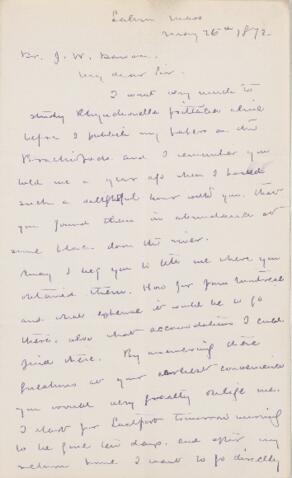
Letter from Edw. S. Morse to John William Dawson, written from Salem, Massachusetts.