
McGill Libraries
McLennan Library Building3459 rue McTavish
Montreal, Quebec
H3A 0C9
Sir Adams George Archibald was born on May 3, 1814, in Truro, Nova Scotia, the son of Samuel and Elizabeth Archibald.
He was a Canadian lawyer and politician, and a Father of Confederation. Although he first wanted to become a doctor, he dropped the profession in favour of law and was called to the bar of Nova Scotia in 1839. He established a practice in Truro and sought a variety of public offices in order to promote his legal business.
He was first elected to the provincial assembly as a Liberal in 1851, one of two members for Colchester County. While in the legislature, he helped to establish a normal school at Truro in 1854, becoming one of its directors. His first office was as solicitor general in 1856, a posting that was cut short by the collapse of the Liberal government. After the Liberals regained power in 1859, he was appointed attorney general. He was also on the committee of negotiators for the Intercolonial Railway in 1862.
When Joseph Howe became imperial fisheries commissioner later that year Archibald acted as government leader until the Conservatives won the 1863 election. He was then invited by Charles Tupper to be one of the delegates to the Charlottetown Conference on the union in September of 1864. He also participated in the conferences at Quebec and London As the financial expert of the delegation, it was Archibald's task to justify the financial arrangements of the Quebec Resolutions to Nova Scotians. In fact, he was the only Liberal in the Nova Scotia Assembly to support the Resolutions. For his efforts in promoting Confederation in the province, he was made secretary of state for the new Canadian federal government in 1867. He resigned the post the following spring in the face of Nova Scotian opposition to union but returned to the federal government in 1869 after winning a by-election in Colchester County.
Archibald's speeches regarding the people of the Red River area led George-Étienne Cartier to offer him the position of lieutenant-governor for the newly created province of Manitoba, and of the Northwest Territories. in 1870. Archibald accepted, on the condition that the posting only be for one year and that he receive an appointment to the Nova Scotia Supreme Court when his term was complete. While in Manitoba, he established the foundations for many basic services, such as school and court systems, and negotiated the first two treaties with the western First Nations. Archibald was knighted for his work in the new province.
When his appointment to the court was delayed, Archibald accepted a position with the Canadian Pacific Railway Company. He was made judge in equity in 1873, but only days later was asked to accept the post of lieutenant-governor of Nova Scotia, after James William Johnston resigned. He held the office until 1883. While it was less eventful than his term in Manitoba, he had to meet the challenge of working with politicians still opposed to Confederation.
In October of 1883, Archibald participated in the inauguration of Dalhousie Law School. The following year, he was asked to lead the campaign for expansion and reorganization of the entire university and was made chairman of its board of governors. Archibald also participated in the founding of the Nova Scotia Historical Society in 1878, serving as the organization's president from 1886 until his death.
In 1888, John A. Macdonald asked Archibald to run in a federal by-election in Colchester County. He carried the seat easily but gave no speeches in the House of Commons, and was too sick to run again in 1891.
In 1843, he married Elizabeth Archibald Burnyeat. He died on December 14, 1892, in Truro, Nova Scotia.
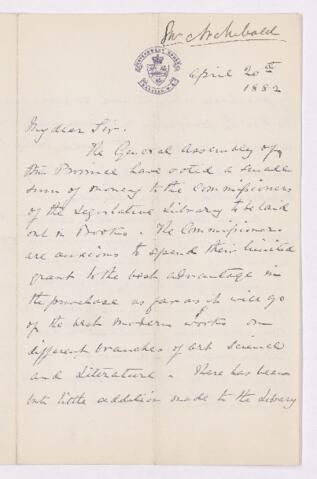
Letter from A.G. Archibald to John William Dawson, written from Halifax.