
McGill Libraries
McLennan Library Building3459 rue McTavish
Montreal, Quebec
H3A 0C9
Mary Carpenter was born on April 3, 1807, in Exeter, Devon, England.
She was an English philanthropist and social reformer, the first child of Dr. Lant Carpenter (1780-1840), a Unitarian minister in Exeter. She studied the sciences, mathematics, Greek and Latin at a school established by her father. Later she became a headteacher at what was now Mrs. Carpenter's Boarding School for Young Ladies. In 1843, she became interested in the anti-slavery movement and contributed to fund-raising efforts in the abolitionist cause. In 1835, she helped organize a "Working and Visiting Society" that visited the poor and raised funds from the emerging middle-classes to alleviate poverty and improve education. She published articles and books on her work and her lobbying was instrumental in the passage of several educational acts in the mid-19th century, e.g., the Juvenile Offenders Act in 1854. She set up a girls' Red Lodge Reformatory (now the Red Lodge Museum) in 1854. She was the first woman to have a paper published by the Statistical Society of London. She addressed many conferences and meetings and became known as one of the foremost public speakers of her time. She also travelled to India, visiting schools and prisons, and working to improve female education, establish reformatory schools, and improve prison conditions. In later years she visited Europe and America, carrying on her campaigns of penal and educational reform. She publicly supported women's suffrage and campaigned for female access to higher education. She has a memorial in the North transept of Bristol Cathedral.
She died on June 14, 1877, in Bristol, Somerset, England.
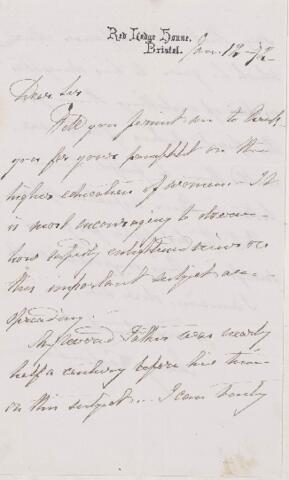
Letter from Mary Carpenter to John William Dawson, written from Bristol.