Item 0010 - Letter, 11 April 1876

Open original Digital object

Title and statement of responsibility area

Title proper

Letter, 11 April 1876

General material designation

    Parallel title

    Other title information

    Title statements of responsibility

    Title notes

    • Source of title proper: Title based on content.

    Level of description

    Item

    Reference code

    CA MUA MG 1022-2-1-098-0010

    Edition area

    Edition statement

    Edition statement of responsibility

    Class of material specific details area

    Statement of scale (cartographic)

    Statement of projection (cartographic)

    Statement of coordinates (cartographic)

    Statement of scale (architectural)

    Issuing jurisdiction and denomination (philatelic)

    Dates of creation area

    Date(s)

    • 11 April 1876 (Creation)
      Creator
      Fleming, Sandford, 1827-1915
      Place
      Ottawa (Ont.)

    Physical description area

    Physical description

    Publisher's series area

    Title proper of publisher's series

    Parallel titles of publisher's series

    Other title information of publisher's series

    Statement of responsibility relating to publisher's series

    Numbering within publisher's series

    Note on publisher's series

    Archival description area

    Name of creator

    (1827-1915)

    Biographical history

    Sir Sandford Arnot Fleming was born on January 7, 1827, in Kirkcaldy, Fife County, Scotland.

    He was a Canadian civil engineer, scientist, and surveyor. He studied surveying in his hometown before immigrating to Canada in 1845. He began accumulating railway experience during the 1850s and 1860s when he served as Chief Engineer of various railways in Upper Canada and Nova Scotia. He also designed Canada's first postage stamp, the three-penny beaver, issued in 1851. In 1867, he was appointed Chief Engineer of the Inter-Colonial Railway, which was to link Nova Scotia to central Canada as part of the Confederation Pact. In 1871, he was made Chief Engineer of the Canadian Pacific Railway, in charge of supervising the construction of the railway that would extend from the Atlantic to the Pacific. Fleming led a gruelling cross-country survey expedition to pick a route for the railway. This surveying mission across Canada gave him the idea for a standard system of time zones. He proposed the system we use today, which was adopted in 1884, and he is known for this as the "Father of Standard Time." In 1880, he took the position of Chancellor of Queen's University in Kingston, Ontario and held it for 35 years. He played a pivotal role in increasing the importance of science at Queen's. He was vice president of the Ottawa Horticultural Society and in 1888, he became the first president of the Rideau Curling Club. In 1897, he was knighted by Queen Victoria. Fleming was designated a National Historic Person in 1950, on the advice of the National Historic Sites and Monuments Board.

    In 1855, he married Ann Jane "Jeannie" Hall (1831–1888). He died on July 22, 1915, in Halifax, Nova Scotia.

    Custodial history

    Scope and content

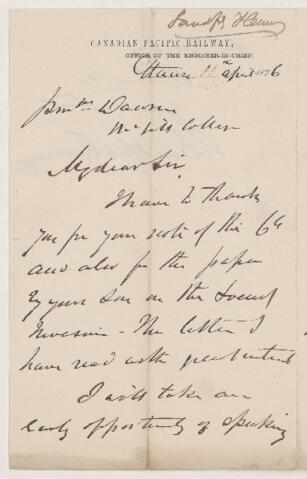
    Letter from Sandford Fleming to John William Dawson, written from Ottawa.

    Notes area

    Physical condition

    Immediate source of acquisition

    Arrangement

    Language of material

      Script of material

        Location of originals

        Availability of other formats

        Restrictions on access

        Terms governing use, reproduction, and publication

        Finding aids

        Associated materials

        Related materials

        Accruals

        Alternative identifier(s)

        Standard number

        Standard number

        Access points

        Subject access points

        Place access points

        Name access points

        Genre access points

        Control area

        Description record identifier

        Institution identifier

        Rules or conventions

        Status

        Level of detail

        Dates of creation, revision and deletion

        Language of description

          Script of description

            Sources

            Digital object (External URI) rights area

            Digital object (Reference) rights area

            Digital object (Thumbnail) rights area

            Accession area