Subseries 90 - Thesis 1960 and Assorted University Projects

Open original Digital object

Title and statement of responsibility area

Title proper

Thesis 1960 and Assorted University Projects

General material designation

    Parallel title

    Other title information

    Title statements of responsibility

    Title notes

    Level of description

    Subseries

    Reference code

    CA CAC 58-1-90

    Edition area

    Edition statement

    Edition statement of responsibility

    Class of material specific details area

    Statement of scale (cartographic)

    Statement of projection (cartographic)

    Statement of coordinates (cartographic)

    Statement of scale (architectural)

    Issuing jurisdiction and denomination (philatelic)

    Dates of creation area

    Date(s)

    • between 1958 and 1961 (Creation)
      Creator
      Safdie Architects

    Physical description area

    Physical description

    architectural drawings : vellum, tracing paper
    architectural drawings : mixed media

    Publisher's series area

    Title proper of publisher's series

    Parallel titles of publisher's series

    Other title information of publisher's series

    Statement of responsibility relating to publisher's series

    Numbering within publisher's series

    Note on publisher's series

    Archival description area

    Name of creator

    Biographical history

    Custodial history

    Scope and content

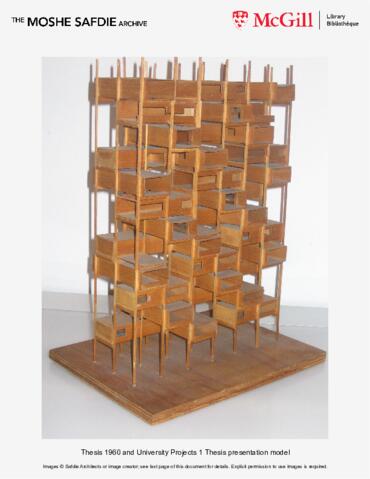
    Moshe Safdie's undergraduate thesis, "A Three-Dimensional Modular Building System," contains all of the concepts that would be realized in Habitat '67 at the World Exposition in Montreal. Officially titled "A Case for City Living," the thesis outlines Safdie's central premise: how can high-density urban housing include the amenities found in low-density suburban housing developments?

    The building system developed in the thesis combines three distinct concepts: an integrated three-dimensional urban structure, a construction system based on three-dimensional modules or boxes, and a system adaptable to a wide range of site conditions. The thesis explores three possible construction systems, applied to a community of 5000, each with its own structural system and geometry. In the first system (single repetitive module), a structural frame supports non-load-bearing, factory-produced modular units. In the second system (bearing-wall construction), the same modules are assembled in a load-bearing arrangement. In the third system (load-bearing module), prefabricated walls are arranged in a crisscross pattern.

    Overall the systems allow for flexibility, identity, privacy, community, and individual outdoor space. The modules may be stacked in many configurations to create a variety of housing types. The flexible arrangement allows for a complex in which no two dwellings are exactly alike and each can be recognized from the exterior. Because the modules are stacked on top of one another, walls and ceilings are doubled up, providing sound attenuation and privacy not achievable in conventional city-apartment high-rise construction. Modules are arranged in a staggered form, stepping back and allowing each roof to become an outdoor terrace for another dwelling. Pedestrian streets and vertical elevator and stair cores form the primary circulation systems. Finally, the modules are manufactured in a factory, lowering the individual-unit cost and allowing for relatively quick construction.

    Notes area

    Physical condition

    Immediate source of acquisition

    Arrangement

    Language of material

      Script of material

        Location of originals

        Availability of other formats

        Includes some digital images.

        Restrictions on access

        Terms governing use, reproduction, and publication

        Finding aids

        Associated materials

        Related materials

        Accruals

        Rights

        © Safdie Architects. Explicit permission to use images is required. Contact the Communications Director at Safdie Architects (617.629.2100) for more information.

        Alternative identifier(s)

        Database ID

        cac_thesis_1960_and_university_projects

        Standard number

        Standard number

        Access points

        Subject access points

        Place access points

        Name access points

        Control area

        Description record identifier

        Institution identifier

        Rules or conventions

        Status

        Level of detail

        Dates of creation, revision and deletion

        Language of description

          Script of description

            Sources

            Source: Safdie Architects hard drive

            Digital object (External URI) rights area

            Digital object (Reference) rights area

            Digital object (Thumbnail) rights area

            Accession area