File 109 - Sidney Webb

Open original Digital object

Title and statement of responsibility area

Title proper

Sidney Webb

General material designation

    Parallel title

    Other title information

    Title statements of responsibility

    Title notes

    • Source of title proper: Title based on contents.

    Level of description

    File

    Reference code

    CA RBD MS 951-1-109

    Edition area

    Edition statement

    Edition statement of responsibility

    Class of material specific details area

    Statement of scale (cartographic)

    Statement of projection (cartographic)

    Statement of coordinates (cartographic)

    Statement of scale (architectural)

    Issuing jurisdiction and denomination (philatelic)

    Dates of creation area

    Date(s)

    • 19 June 1930 - 29 January 1937 (Creation)
      Creator
      Webb, Sidney, 1859-1947
      Place
      London (England)

    Physical description area

    Physical description

    3 letters

    Publisher's series area

    Title proper of publisher's series

    Parallel titles of publisher's series

    Other title information of publisher's series

    Statement of responsibility relating to publisher's series

    Numbering within publisher's series

    Note on publisher's series

    Archival description area

    Name of creator

    (1859-1947)

    Biographical history

    Sidney James Webb, 1st Baron Passfield, was born on July 13, 1859, in London, England.

    He was a British social reformer, economist, and historian. He studied law at the Birkbeck Literary and Scientific Institution and King's College London. He was called to the Bar at Gray's Inn, and, in 1886, he obtained his LL.B. from London University. In 1885, G.B. Shaw introduced Webb to the Fabian Society, and he wrote for it on poverty in London, the eight-hour day, land nationalization, the nature of socialism, education, eugenics, and reform of the House of Lords, e.g., "Facts for Socialists" (1887) and "Facts for Londoners" (1889). They turned the Fabian Society into the pre-eminent politico-intellectual society in Edwardian England. In 1913, together with his wife, Webb founded the New Statesman magazine. In 1895, he helped found the London School of Economics and served as its Professor of Public Administration from 1912 to 1927. In 1929, he was created Baron Passfield of Passfield Corner in the County of Southampton. He served as Secretary of State for the Colonies (1929-1930) and as Secretary of State for Dominion Affairs (1930-1931). Webb was appointed to the Order of Merit in 1944 and received honorary degrees from the Universities of London, Wales, and Munich. He wrote the original, pro-nationalization Clause IV for the British Labour Party. Webb co-authored with his wife Beatrice “The History of Trade Unionism” (1894) and “Soviet Communism: a New Civilisation?” (2 vols., 1935).

    In 1892, he married Martha Beatrice Potter (1858–1943). He died on October 13, 1947, in Liphook, Hampshire, England.

    Custodial history

    Scope and content

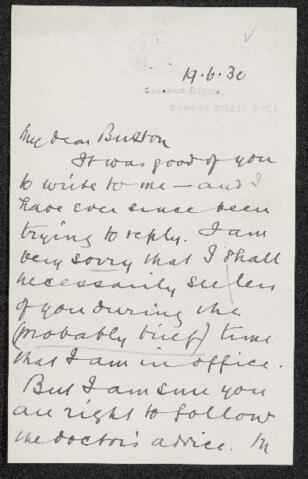
    Letters from Sidney Webb to Noel Buxton. One letter signed Passfield, Webb's title.

    Notes area

    Physical condition

    Immediate source of acquisition

    Arrangement

    Language of material

      Script of material

        Location of originals

        Availability of other formats

        Restrictions on access

        Terms governing use, reproduction, and publication

        Finding aids

        Associated materials

        Related materials

        Accruals

        Alternative identifier(s)

        Standard number

        Standard number

        Access points

        Subject access points

        Place access points

        Name access points

        Genre access points

        Control area

        Description record identifier

        Institution identifier

        Rules or conventions

        Status

        Level of detail

        Dates of creation, revision and deletion

        Language of description

          Script of description

            Sources

            Digital object (External URI) rights area

            Digital object (Reference) rights area

            Digital object (Thumbnail) rights area

            Accession area