Item 47 - Letter, Raymond Crawfurd

Open original Digital object

Title and statement of responsibility area

Title proper

Letter, Raymond Crawfurd

General material designation

    Parallel title

    Other title information

    Title statements of responsibility

    Title notes

    Level of description

    Item

    Repository

    Reference code

    CA OSLER P417-2-5-47

    Edition area

    Edition statement

    Edition statement of responsibility

    Class of material specific details area

    Statement of scale (cartographic)

    Statement of projection (cartographic)

    Statement of coordinates (cartographic)

    Statement of scale (architectural)

    Issuing jurisdiction and denomination (philatelic)

    Dates of creation area

    Date(s)

    Physical description area

    Physical description

    1 page

    Publisher's series area

    Title proper of publisher's series

    Parallel titles of publisher's series

    Other title information of publisher's series

    Statement of responsibility relating to publisher's series

    Numbering within publisher's series

    Note on publisher's series

    Archival description area

    Name of creator

    (1865-1938)

    Biographical history

    Sir Raymond Henry Payne Crawfurd was born on November 9, 1865, in East Grinstead, Sussex, England.

    He was a British physician, educator, and writer. In 1888, he graduated from Oxford University with a degree in classics. Then he studied medicine at the King's College Hospital Medical School in London, graduating in 1894. The same year he founded the Musical Society at Oxford. He worked at the King's College Hospital, the Victoria Hospital for Children, the Royal Free Hospital, National Provident Institution, and the Life Association of Scotland. At the turn of the 19th century, he became Registrar to the Royal College of Physicians (RCP), a position he retained for thirteen years. Crawfurd delivered the Fitzpatrick Lectures (1911–1912) and, in 1919, was Harveian Orator. He also lectured on pathology and on Materia medica at the London School of Medicine for Women. In 1913, he became a major contributor at an International Conference on postgraduate medical education. Crawfurd was also a member of the Board of Examiners at the RCP, the chairman of the Medical Graduates’ College, and the Epsom College. In 1933, he was awarded a knighthood. He is the author of the books “The Last Days of Charles II” (1909), “The King's Evil” (1911) and “Plague and Pestilence in Literature and Art” (1914).

    In 1898, he married Ethelberta Ormrod Bailey (1866–1950). He died on March 9, 1938, in London, England.

    Custodial history

    Scope and content

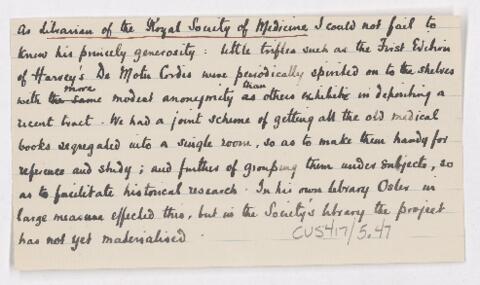
    Letter from Raymond Crawfurd. Raymond Crawfurd, Librarian of the Royal Society of Medicine, writes of Osler's princely generosity. Osler had a habit of procuring extremely rare volumes for the Library, such as Harvey's "De Motu Cordis," and sneaking them onto the shelves with modest anonymity.

    Notes area

    Physical condition

    Good condition.

    Immediate source of acquisition

    Arrangement

    Language of material

      Script of material

        Location of originals

        Availability of other formats

        Restrictions on access

        Terms governing use, reproduction, and publication

        Finding aids

        Associated materials

        Related materials

        Accruals

        General note

        Original.

        General note

        Cushing's colour code: White (Correspondence)

        Alternative identifier(s)

        Cushing ID

        CUS417/5.47

        Standard number

        Standard number

        Access points

        Subject access points

        Place access points

        Name access points

        Genre access points

        Control area

        Description record identifier

        Institution identifier

        Rules or conventions

        Status

        Level of detail

        Dates of creation, revision and deletion

        Language of description

          Script of description

            Sources

            Digital object (External URI) rights area

            Digital object (Reference) rights area

            Digital object (Thumbnail) rights area

            Accession area