
McGill Libraries
McLennan Library Building3459 rue McTavish
Montreal, Quebec
H3A 0C9
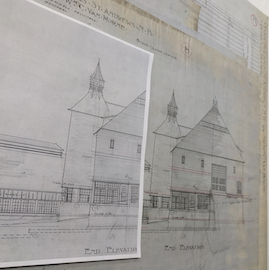
108 drawings: 59 ink on linen; 7 ink on paper; 19 pencil on paper; 1 watercolour on paper; 17 blueprints; 5 photostats
53 photographs
University building (basement, 4 floors); brick and stone; brick and terracotta; wall bearing.
2 sketch drawings: faculty room, elevation
8 presentation drawings: bird's-eye view, site plan, front elevation, north elevation, view looking north, sculpture over window
43 working drawings: floor plans, roof plan, elevations, sections, assembly hall, stage, gallery, convocation hall
48 detail drawings: elevations, room interiors and plans, stone work (incl. entrance, column, elevations), air inlets, electric outlets, classroom, ventilating fleche, finishes, stairs, balconies, entrance, windows, convocation hall, hallway, terracotta, staircase, arch, footings, foundation walls
7 record drawings: floor plans, elevation
53 photographs: 7 elevations; 7 plans; 6 perspectives; 13 finished exteriors; 13 finished interiors; 8 others
Important watercolour presentation drawings relating to Arts Building, Medical Building, and General Scheme are in the University of Alberta Archives and in the Canadian Architectural Archives, University of Calgary. CAC has colour photograph of General view looking north showing scheme of building proposed in 1912 by Percy E. Nobbs and Frank Draling, consultant architect. Original presentation drawing is in University of Alberta archives.
The first of the buildings Nobbs was commissioned to construct on the University of Alberta campus was the Arts Building. Originally started by the provincial architect, A.M. Jeffers, work was halted by cuts to provincial funding. The design for the arts building underwent several dramatic reductions in scale before its final realisation. Most notably, the first design for the arts building was marked by a lofty landmark tower that was subsequently isolated from the building and ultimately abandoned. Nobbs redesigned the Arts Building in 1913 in collaboration with Frank Darling, then Canada’s premier architect. The building was executed in the “elastic free classical style” he proposed for the entire campus, and was heavily laced with baroque forms. The brickwork was finely executed in richly textured brick, laid out in a ‘cross’ or ‘broken’ English bond. The base of the building and its details are stone. Due to the outbreak of the war, the stone carvings designed by Nobbs were never carried out. The building was completed at the end of 1915 under the guidance of Cecil Burgess [resident architect at the University of Alberta] save for two special rooms that were completed by Nobbs after the war. One of these rooms, the faculty room [now senate chamber] is notable for its fine plasterwork, oval shape, and dome. The building also contains a convocation hall at its rear. The rear elevations of the building are executed in simpler, more economical construction, as compared to the more ornate public face of the building. The roof of the building is covered with “saw toothed” skylights, which are hidden from view by an ornamental balustrade.