
McGill Libraries
McLennan Library Building3459 rue McTavish
Montreal, Quebec
H3A 0C9
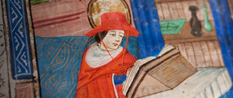
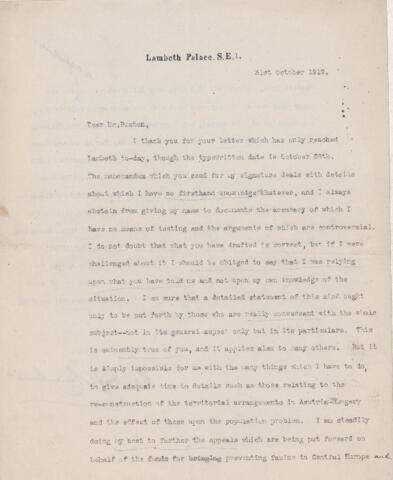
6 letters
Randall Thomas Davidson, 1st Baron Davidson of Lambeth, was born on April 7, 1848, in Edinburgh, Scotland.
He was an Anglican clergyman. He was educated at Harrow School and Trinity College, Oxford. He was ordained priest in 1875 and became chaplain and secretary to the Archbishop of Canterbury (1876-1883). He rose through church hierarchy, becoming Dean of Windsor and domestic chaplain to Queen Victoria (1883–1891), Clerk of the Closet to the Sovereign (1891–1903), Bishop of Rochester (1891–1895), and Bishop of Winchester (1895–1903). From 1903 to 1928, Davidson was Archbishop of Canterbury, the longest-serving holder of the office since the Reformation, and the first to retire from it. Under his leadership, the Church gained some independence from state control, but his efforts to modernize the Book of Common Prayer were defeated by Parliament. His honours included a Knight Commander of the Royal Victorian Order in 1902, a Privy Counsellor in 1903, and a Knight Grand Cross of the Royal Victorian Order in 1904. In 1928, he was raised to the peerage as Baron Davidson of Lambeth, of Lambeth in the County of London.
In 1878, he married Edith Murdoch Tait, Baroness of Starrs House, the Precincts Canterbury (1858–1936). He died on May 25, 1930, in London, England.
William Cosmo Gordon Lang, 1st Baron Lang of Lambeth, was born on October 31, 1864, in Fyvie Manse, Aberdeenshire, Scotland.
He was a Scottish Anglican clergyman. He was educated at the University of Glasgow (M.A., 1882) and Balliol College, Oxford (1886). In 1887, he began his studies for the English Bar and in 1888, he was elected to an All Souls Fellowship. In 1889, after attending evening service at the theological college in Cuddesdon, Oxfordshire, he renounced his political ambitions and applied to Cuddesdon College. In 1890, he was ordained as a deacon and served in slum parishes in Leeds and Portsmouth. In 1901, he was appointed suffragan Bishop of Stepney in London, where he continued his work among the poor. He also served as a canon of St. Paul's Cathedral, London. In 1909, he was appointed Archbishop of York at the age of 44 and was seated at York Minster, York. In addition to his diocesan responsibilities for York, he became head of the entire Northern Province and a member of the House of Lords. He spoke out on various social and economic issues and supported improved working conditions. He voted against the 1914 Irish Home Rule Bill and opposed the liberalization of the divorce laws. In 1923, King George V awarded him the Royal Victorian Chain, and in 1926, he baptized Princess Elizabeth, the future Queen Elizabeth II, in the private chapel of Buckingham Palace. In 1928, he became Archbishop of Canterbury. Throughout the 1930s, Lang became a strong supporter of the government's policy of appeasing the European dictators. He had preached before Queen Victoria and was close to the royal family during the period leading to the abdication of Edward VIII. He resigned in 1942. Upon his retirement, he was raised to the peerage as Baron Lang of Lambeth in the County of Surrey. He received an honorary degree of Doctor of Divinity from Oxford University in 1901. He wrote several books, e.g., "The Young Clanroy" (1897), "The Miracles of Jesus" (1901), "The Opportunity of the Church of England" (1905), "Thoughts on Some of the Parables of Jesus" (1909), "The Unity of the Church of England" (1925), and "The Oppression of Religion in Russia" (1930).
He died on December 5, 1945, in Richmond, Surrey, England.
William Temple was born on October 15, 1881, in Exeter, Devon, England, son of Frederick Temple (1821-1902), Archbishop of Canterbury (1896–1902).
He was an English Anglican clergyman, educator, and author. He was educated at Rugby and Balliol College, Oxford, where he was president of the Oxford Union. He was a lecturer in philosophy at the Queen's College, Oxford (1904-1910) before becoming headmaster of Repton School (1910-1914). He was ordained a priest in 1909. After serving as a rector of St. James's Church, Piccadilly, London (1914-1917) and as a canon of Westminster Abbey in 1919, he was appointed Bishop of Manchester in 1921. In 1924, he chaired the interdenominational Conference on Christian Politics, Economics, and Citizenship at Birmingham. He served as Chairman of the Commission on Christian doctrine appointed by the archbishops (1925-1937) and was the principal preacher at a Cambridge University mission in 1926. From 1929 to 1942, he served as Archbishop of York. In 1942, he was appointed Archbishop of Canterbury, a position he held until he died in 1944. He was one of the founders of the Council of Christians and Jews in 1942. In March 1943, Temple addressed the House of Lords, urging action to be taken on the atrocities carried out by Nazi Germany. He wrote constantly and completed his largest philosophical work, “Mens Creatrix” in 1917. In 1932–1933, he gave the Gifford Lectures, published in 1934 as “Gifford Lectures, Nature, Man, and God”. He was the author of "Christianity and Social Order" (1942) and "The Church Looks Forward" (1944).
In 1916, he married Frances Gertrude Acland Anson (1890–1984). He died on October 26, 1944, in Westgate-on-Sea, Kent, England.
Letters from three Archbishops of Canterbury to Noel Noel-Buxton: Randall Davidson, Cosmo Gordon Lang, and William Temple. Includes two draft responses from Noel-Buxton. The correspondence concerns political issues of the First and Second World Wars, incl