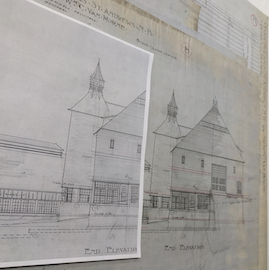
File 17.0 - AI Ain University Competition (United Arab Emirates University, University Town Project)

Title and statement of responsibility area

Title proper

AI Ain University Competition (United Arab Emirates University, University Town Project)

General material designation

    Parallel title

    Other title information

    Title statements of responsibility

    Title notes

    Level of description

    File

    Reference code

    CA CAC 57-1-17.0

    Edition area

    Edition statement

    Edition statement of responsibility

    Class of material specific details area

    Statement of scale (cartographic)

    Statement of projection (cartographic)

    Statement of coordinates (cartographic)

    Statement of scale (architectural)

    Issuing jurisdiction and denomination (philatelic)

    Dates of creation area

    Date(s)

    • 1987 (Creation)

    Physical description area

    Physical description

    87 drawings
    20 photographs

    Publisher's series area

    Title proper of publisher's series

    Parallel titles of publisher's series

    Other title information of publisher's series

    Statement of responsibility relating to publisher's series

    Numbering within publisher's series

    Note on publisher's series

    Archival description area

    Name of creator

    Custodial history

    Scope and content

    FIle consists of 87 drawings and 20 photographs prepared for Sheik Aid bin Naraya, Minister of Education, United Arab Emirates. The competition design prepared for this proposed University, in the oasis city of AI Ain in the United Arab Emirates, sought to provide a modem interpretation of the historical principles of Islamic design. The project was conceived as an axial plan with crossing axes at the entries to the various faculties, achieving their own specific identity. Particularly important was the need to weave the existing buildings of the University into the plan. An architectural vocabulary was developed as a reinterpretation of "desert" architecture, whereby walls were conceived massively in nature with small punched openings to admit light. Such walls protected the inner spaces from the harsh surrounding environment and these spaces were to be enriched in a variety of ways. Spaces were conceived in a hierarchical manner by means of size and finish material. Courtyards, some internalized and climate controlled, became the focus of the architecture, and were protected from the environment by high walls and overhead trellises. Each courtyard was provided with a decorative water feature and appropriate landscaping. In keeping with most Islamic buildings, particular emphasis was placed on the internal nature of space, doorways, passages, and gates to each space. The major entrance to the project is approached directly by the main axis where an enveloping semicircular administration building accepts visitors and dignitaries. The axial plan is broken only by the various "prayer" spaces, or Mosques, which turn in the direction of Mecca. Particularly important to the project were the series of gates at the axial entry points, giving the project its outward architectural richness.

    Notes area

    Physical condition

    Immediate source of acquisition

    Arrangement

    Language of material

      Script of material

        Location of originals

        Availability of other formats

        Restrictions on access

        Terms governing use, reproduction, and publication

        Finding aids

        Associated materials

        Related materials

        Accruals

        General note

        Competition submission, unbuilt.

        General note

        Project Breakdown:
        17.1 Master Plan and Conceptual Drawings
        17.2 Entrance Area and Surrounding Structures
        17.3 Faculty of Medicine and Health Science
        17.4 Central Administration Building
        17.5 Non-Laboratory Facilities
        17.6 Conference Centre and Auditorium
        17.7 Zoning and Circulation

        Alternative identifier(s)

        Standard number

        Standard number

        Access points

        Subject access points

        Place access points

        Name access points

        Control area

        Description record identifier

        Institution identifier

        Rules or conventions

        Status

        Level of detail

        Dates of creation, revision and deletion

        Language of description

          Script of description

            Sources

            Accession area