Item 014 - Tufted capuchin

Open original Digital object

Title and statement of responsibility area

Title proper

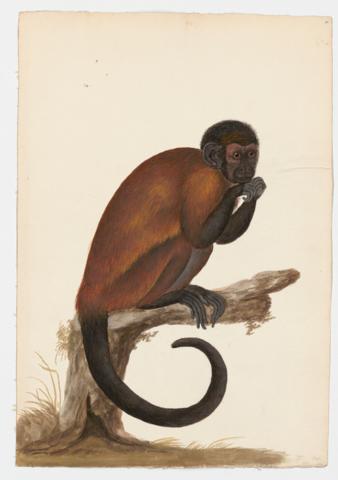
Tufted capuchin

General material designation

    Parallel title

    Other title information

    Sapajus apella

    Title statements of responsibility

    Title notes

    • Source of title proper: Title based on 2019 species identification.

    Level of description

    Item

    Reference code

    CA RBD MSG BW002-014

    Edition area

    Edition statement

    Edition statement of responsibility

    Class of material specific details area

    Statement of scale (cartographic)

    Statement of projection (cartographic)

    Statement of coordinates (cartographic)

    Statement of scale (architectural)

    Issuing jurisdiction and denomination (philatelic)

    Dates of creation area

    Date(s)

    • undated (Creation)
      Creator
      Paillou, Peter, approximately 1720-approximately 1790

    Physical description area

    Physical description

    1 watercolour painting ; 56 x 39 cm

    Publisher's series area

    Title proper of publisher's series

    Parallel titles of publisher's series

    Other title information of publisher's series

    Statement of responsibility relating to publisher's series

    Numbering within publisher's series

    Note on publisher's series

    Archival description area

    Name of creator

    (approximately 1720-approximately 1790)

    Biographical history

    Peter Paillou was born in London into a Huguenot family and was recognised in his own time as an eminent ‘bird painter’. In 1744 he began to paint for Taylor White and worked for him for almost thirty years, painting chiefly birds and mammals. He painted as well for Robert More, Joseph Banks, and for the Welsh naturalist Thomas Pennant. Many of his paintings of birds were used as the basis for book illustrations, often engraved by his colleague and fellow Huguenot, Peter Mazell. Paillou was elected to the Society of Artists and in 1763 he exhibited ‘A Piece of Birds, in Watercolours; the Hen of the Wood and Cock of the Red Game’. In 1778, to considerable approval, he also showed a picture of ‘A Horned Owl from Peru’, completely made from feathers.

    Custodial history

    Scope and content

    Drawing of a Tufted capuchin from a 18th century specimen [modern geographical distribution: South America.] Attributed to Peter Paillou.

    Notes area

    Physical condition

    Immediate source of acquisition

    Arrangement

    Language of material

      Script of material

        Location of originals

        Availability of other formats

        Restrictions on access

        Terms governing use, reproduction, and publication

        Finding aids

        Associated materials

        Related materials

        Accruals

        General note

        Scientific name: Sapajus apella

        Accompanying material

        Transcription of manuscript note on accompanying leaf: Mammalia Primates Simia Cercopithecus

        1. Paniscus
          Cercopithecus in pedibus anterioribus pollice
          carens, cauda inferius apicem pilis destituta
          Briss. quadr. 211.
          Simia fusca, major, palmis tetradactylis, cauda
          prehensili ad apicem subtus nuda Brown Jam. 489
          Simia caudata imberbis atra, cauda prehensili
          Palmis tetradactylis. L.S.N. p. 37
          Habitat in America meridionali.
          Corpus atrum, magnitudine mollosi.
          Pedes & cauda dimidia exteriorior [exterior] bruneae;
          cauda extremitas hinc nuda, qua, quicquid e terra
          elevet, prehendit. Digiti pedum 4-5.
          Z. Hallman; est vero Pollex digiti Pedum reliquis
          minor, introrsum a ceteris remotis.
          unguesq[ue] manuum rotundati; pedum oblongiusculi.
          D. Aymen Facies nuda, rubra, auriculae nudae.

        That which I saw was wholy black as in
        the Drawing

        Accompanying material

        Translation of manuscript note on accompanying leaf: Mammalia Primate Simia Cercopithecus

        1. Paniscus
          Cercopithecus lacking a thumb on the fore-feet,
          with a tail that is entirely hairless under the tip.
          Briss. quadr. 211.
          The large tawny simia with four-fingered hands, a prehensile
          tail that is bare underneath at the tip. Brown Jam. 489
          The black, tailed, and beardless simia, with a prehensile tail,
          and four-fingered hands. L.S.N. p. 37
          It lives in South America.
          The body is black, it is the size of a Molossian hound.
          The feet and tail are brown on the outer half;
          the tail is bare at the tip, with which, whenever it lifts itself from the
          ground, it holds on. There are 4-5 toes on the feet.
          Z. Hallman; The thumb is truly smaller than the rest of the
          fingers, it is to the inside and far removed from the others.
          The nails of the hands are round; the feet are a little longer than wide. D. Aymen The face is bare, and red, with bare ears.

        That which I saw was wholy black as in
        the Drawing

        Alternative identifier(s)

        Volume number

        Mammals Volume 1, Painting 14

        Standard number

        Standard number

        Access points

        Subject access points

        Place access points

        Name access points

        Genre access points

        Control area

        Description record identifier

        Institution identifier

        Rules or conventions

        Status

        Level of detail

        Dates of creation, revision and deletion

        Language of description

          Script of description

            Sources

            Digital object (External URI) rights area

            Digital object (Reference) rights area

            Digital object (Thumbnail) rights area

            Accession area