
McGill Libraries
McLennan Library Building3459 rue McTavish
Montreal, Quebec
H3A 0C9
James Booth had an inauspicious start in life before going on to become one of England’s most beloved and successful comic music-hall singers and songwriter-composers of the early 20th century. Illegitimate son of an alcoholic prostitute in Croydon, Surrey, he had a miserable childhood, mostly having to fend for himself, often sleeping outdoors. He was a truant by age nine and didn’t learn to read till his teens. His presumed father, Francis Lawler, who had married his mother six months after his birth, died in 1890, and the boy worked in a cotton mill as a loom builder for two years. He supplemented the meagre wages by singing on street corners and later in pubs with another boy – they called themselves the Glenray Brothers. Though successful, this act ended when Booth’s soprano voice cracked. He began to develop an act of his own in the 1890s -- various characters with their own comic personalities – and composed songs to go with them. One of his earliest personae was ”John Willie,” a Chaplinesque Lancashire lad with baggy trousers and bowler hat who somehow muddled through. In fact, in 1908, he loaned the costume to young Chaplin himself who was just starting his career. Chaplin adopted the costume as well as the cane twirling and duck-like walk for his own act. In 1897 Booth changed his stage name from J.H Booth to George Formby. That same year he married Martha Maria Slater, but the next year he began a bigamous marriage with Eliza Hoy, with whom he had 13 children, seven of whom survived. Formby’s act became so successful that he was booked to perform in London in 1902 and by 1913 gave two command performances for King George. He also began a prolific recording career in 1906. He had incorporated into his act his frequent coughing. This was exacerbated when a stage collapsed on him in 1916, during a rehearsal for the revue Razzle Dazzle; the accident caused serious lung damage. Tuberculosis and the Spanish flu of 1918 worsened his health, but he kept performing. He died a rich man and left Eliza a considerable fortune. He had tried to warn his son away from a stage career, but his warning was not heeded. George Hoy Booth changed his name to George Formby Junior and became Britain’s highest paid entertainer of the 1930s and 1940s.
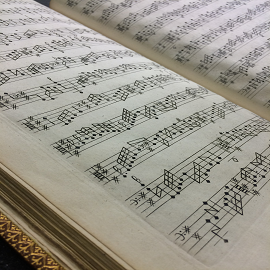
Sol-Fa notation included.