
McGill Libraries
McLennan Library Building3459 rue McTavish
Montreal, Quebec
H3A 0C9
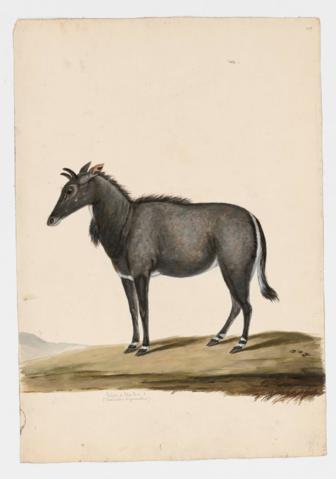
1 watercolour painting ; 56 x 39 cm + 1 leaf
Peter Paillou was born in London into a Huguenot family and was recognised in his own time as an eminent ‘bird painter’. In 1744 he began to paint for Taylor White and worked for him for almost thirty years, painting chiefly birds and mammals. He painted as well for Robert More, Joseph Banks, and for the Welsh naturalist Thomas Pennant. Many of his paintings of birds were used as the basis for book illustrations, often engraved by his colleague and fellow Huguenot, Peter Mazell. Paillou was elected to the Society of Artists and in 1763 he exhibited ‘A Piece of Birds, in Watercolours; the Hen of the Wood and Cock of the Red Game’. In 1778, to considerable approval, he also showed a picture of ‘A Horned Owl from Peru’, completely made from feathers.
Drawing of a male Nilgai from a 18th century specimen [modern geographical distribution: India.] Attributed to Peter Paillou.
Manuscript note on front of drawing: Nilgai or Blue Bull [male] (Boselaphus tragocamelus)
Manuscript note on back of drawing: called the Nedlguy This Goat was brought by Gov Crommelin as a present to Lord Clive from Bengal probably from the country near Dely he called it the Cow Deer which name must have been given it from its horns it came over in the year 1767
Scientific name: Boselaphus tragocamelus
With manuscript text on accompanying leaf.
Transcription of manuscript note on accompanying leaf: Mammalia Pecora
The Cow Deer or Neel Gojay
This Beast with the Female was brought from
Benghall & presented to Ld Clive by Gov. Cranwell in
the year 1767 probably came from the Country near Dely
the Male horned with smooth horns of a shining
black bending forward. the head & ears shaped
like those of a horse a black mane from the top
of the head to ye midst of the Back. a black
Tuft of hair like a beard on the underside of the
neck as in some Goats. its size equals a stag.
its colour a Dark lead colour mixed with white horns
the underside of the neck breast belly & Tail are White
The tail black on the top shaped like an Apes tail.
The feet divided as in Deer. a white line is over each
of the fore feet & two white strokes divided by a black
line over each hind foot. The haunches under the Tail
have a white line.
The female difers from the Male in having no
horns & being of a light brown colour & also
the young one was of the same colour.
It can not be classed among the Cervi because
it does not change its horns.
the mane & beard under the throat resembles
the moose Deer.
the whole form of its body Divers too much
from the Goats particularly its head & tail that
it can not properly come in to the that class
so that I considered it as a new Genus undescri
-bed by any author which I have met with.
Translation of manuscript note on accompanying leaf: Mammalia Pecora
The Cow Deer or Neel Gojay
This Beast with the Female was brought from
Benghall & presented to L[or]d Clive by Gov[ernor] Cranwell in
the year 1767 probably came from the Country near Dely
the Male horned with smooth horns of a shining
black bending forward. the head & ears shaped
like those of a horse a black mane from the top
of the head to [the] midst of the Back. a black
Tuft of hair like a beard on the underside of the
neck as in some Goats. its size equals a stag.
its colour a Dark lead colour mixed with white horns
the underside of the neck breast belly & Tail are White
The tail black on the top shaped like an Apes tail.
The feet divided as in Deer. a white line is over each
of the fore feet & two white strokes divided by a black
line over each hind foot. The haunches under the Tail
have a white line.
The female difers from the Male in having no
horns & being of a light brown colour & also
the young one was of the same colour.
It can not be classed among the Cervi because
it does not change its horns.
the mane & beard under the throat resembles
the moose Deer.
the whole form of its body Divers too much
from the Goats particularly its head & tail that
it can not properly come in to the that class
so that I considered it as a new Genus undescri
-bed by any author which I have met with.