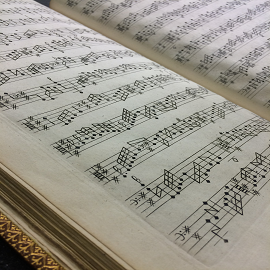
Item 1123 - Ne le dis à personne

Title and statement of responsibility area

Title proper

Ne le dis à personne

General material designation

    Parallel title

    Other title information

    Song with piano accompaniment

    Title statements of responsibility

    Title notes

    Level of description

    Item

    Reference code

    CA MDML 015-2-1123

    Edition area

    Edition statement

    Edition statement of responsibility

    Class of material specific details area

    Statement of scale (cartographic)

    Statement of projection (cartographic)

    Statement of coordinates (cartographic)

    Statement of scale (architectural)

    Issuing jurisdiction and denomination (philatelic)

    Dates of creation area

    Date(s)

    Physical description area

    Physical description

    Publisher's series area

    Title proper of publisher's series

    Parallel titles of publisher's series

    Other title information of publisher's series

    Statement of responsibility relating to publisher's series

    Numbering within publisher's series

    Note on publisher's series

    Archival description area

    Name of creator

    (1891-1976)

    Biographical history

    French composer and conductor Charles Chobillon wrote songs and music starting in the early 1900s; he first became a member of SACEM (Société des auteurs, compositeurs et éditeurs de musique) in 1907. He wrote for musical revues for two decades in the 1930s and 1940s, including at the Théâtre des nouveautés. His best-known work was as conductor of the orchestra of the Concert Mayol, a popular Parisian cabaret that after World War II became notorious for its sexy nude spectacles. At Concert Mayol in the late 1930s he composed and conducted for various revues and tableaux, including for Charles Cluny and Victor Vallier. In 1934 the orchestra accompanied the “revues nus” of André Denis and Paul Lefebvre. He scandalized some when he arranged for his daughter Simone’s debut as a dancer in one of the Mayol shows. Simone later became an actress and singer, appearing in several films. Post-war, Chobillon composed a “Marseillaise” operetta.

    Name of creator

    (1887-)

    Biographical history

    Jane (or Jeanne) Dumont, was born Jeanne Lucie Breton in 1887, in Chaux-de-Fonds, Switerland. She married lyricist Ernest Francois Dumont, best known for his collaborations with Louis Benech in 1909. In 1923 she appeared in the silent film, “L’enfant roi,” filmed at Versailles; in the cast listing she is named as “Madame Dumont.” The newspaper Figaro mentions her in connection with another performance at the Théâtre de la Madeleine in 1925. Her husband formed a music publishing company, “Benech et Dumont,” with his collaborator, who died in 1925. When she was widowed in 1941, she took over the company with the help of Guy Sella. She herself began writing lyrics, often with Sella. Perhaps the first was “Sonnez les clochers de France” in 1943. The catalogue list on the back of the sheet music they brought out for “C’est la France de demain” (1946) cites over 60 titles. There is confusion about the date of her death. The archives of the Société des auteurs, compositeurs et éditeurs de musique (SACEM) have two other members who signed themselves “J. Dumont” from approximately the same period: Jules Dumont, another lyricist and Jan Dumont, an illustrator.

    Name of creator

    Biographical history

    Custodial history

    Scope and content

    Notes area

    Physical condition

    Immediate source of acquisition

    Arrangement

    Language of material

      Script of material

        Location of originals

        Availability of other formats

        Restrictions on access

        Terms governing use, reproduction, and publication

        Finding aids

        Associated materials

        Related materials

        Accruals

        General note

        Included in "Les chansons de Paris no. 3"

        Alternative identifier(s)

        Accession no.

        D1123

        Standard number

        Standard number

        Access points

        Subject access points

        Place access points

        Name access points

        Genre access points

        Control area

        Description record identifier

        Institution identifier

        Rules or conventions

        Status

        Level of detail

        Dates of creation, revision and deletion

        Language of description

          Script of description

            Sources

            Accession area