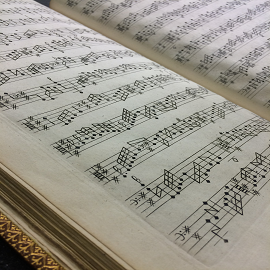
Item 1140 - Mi viejo amor

Title and statement of responsibility area

Title proper

Mi viejo amor

General material designation

    Parallel title

    Other title information

    Song with piano accompaniment

    Title statements of responsibility

    Title notes

    Level of description

    Item

    Reference code

    CA MDML 015-2-1140

    Edition area

    Edition statement

    Edition statement of responsibility

    Class of material specific details area

    Statement of scale (cartographic)

    Statement of projection (cartographic)

    Statement of coordinates (cartographic)

    Statement of scale (architectural)

    Issuing jurisdiction and denomination (philatelic)

    Dates of creation area

    Date(s)

    Physical description area

    Physical description

    Publisher's series area

    Title proper of publisher's series

    Parallel titles of publisher's series

    Other title information of publisher's series

    Statement of responsibility relating to publisher's series

    Numbering within publisher's series

    Note on publisher's series

    Archival description area

    Name of creator

    (1894-1950)

    Biographical history

    The son of a musician, Mexican composer Alfonso Esparza Oteo was the second of ten children. His father, leader of a band and director of a music school in Aguascalientes, taught him to play the piano. Later he attended the Academia del Presbytero Fermín Ramírez where he studied with three teachers: Juan María Cisneros for piano, Arnulfo Miramontes for organ and singing, and Manuel M. Ponce for composition. By 1912 he was playing the piano at the Actualidades theater, improvising music to accompany the films shown. In 1914 he joined Pancho Villa’s army for two years, attaining the rank of major. Returning to music, the first piece he composed, while attending the Escuela de Artes y Oficios de Aguascalientes was “Foxtrot.” In 1919, he and his friends began publishing their own compositions in Mexico City and distributing them around the country. This led to a success with his “Un Amor Viejo” (co-written with Adolfo Fernández) at the Teatro Lírico in 1920. His father’s death the same year meant that he had to shoulder responsibility for his mother and numerous siblings, but he was becoming a fashionable composer during the 1920s. President Álvaro Obregón named him director of the Orquesta Típica Presidential. When General Plutarco Elías Calles took over, this orchestra was disbanded, but Esparza Oteo started another one under his name, and when Obregón was re-elected in 1928, Esparza Oteo again directed the Orquesta Típica. In addition to composing, directing several companies and institutions, he also performed with the quartet “Ases de la Canción” and its successor, “Trio Veneno.” He was an activist for the rights of composers and was the first general secretary for the Sindicato Mexicano de Autores, Compositores y Editores. Among his best-known songs are “Dime que sí,” and “Déjame llorar.” The Discography of American Historical Recordings cites 219 records under his name. Many streets are named for him in towns across Mexico.

    Custodial history

    Scope and content

    Notes area

    Physical condition

    Immediate source of acquisition

    Arrangement

    Language of material

      Script of material

        Location of originals

        Availability of other formats

        Restrictions on access

        Terms governing use, reproduction, and publication

        Finding aids

        Associated materials

        Related materials

        Accruals

        Alternative identifier(s)

        Accession no.

        D1140

        Standard number

        Standard number

        Access points

        Subject access points

        Place access points

        Name access points

        Genre access points

        Control area

        Description record identifier

        Institution identifier

        Rules or conventions

        Status

        Level of detail

        Dates of creation, revision and deletion

        Language of description

          Script of description

            Sources

            Accession area