
McGill Libraries
McLennan Library Building3459 rue McTavish
Montreal, Quebec
H3A 0C9
1 folded sheet (4 unnumbered pages) ; 18.5 x 11.5 cm
1 booklet (10 pages) ; 31.8 cm
Charles Burney was born on December 4, 1757, in King's Lynn, Norfolk. He was the second surviving son of Charles Burney (1726-1814) and his first wife, Esther Sleepe (c.1725-1762). At the age of ten, he began attending the Charterhouse School through the recommendation of George Spencer, fourth duke of Marlborough.
Cambridge
In January 1777, at the age of nineteen, Charles was admitted to Gonville and Caius College at Cambridge. He was not, however, admitted as a 'scholar', but rather as a 'pensioner' or 'commoner' (a student who was required to pay for his own tuition and college fees).
Theft of Books
In October 1778, Charles was discovered to have stolen books from the university library. He had taken the Cambridge nameplate out of the front, replaced it with his own, and had sold the books to London book dealers. His sister Frances later tried to explain Charles' crime as an overly strong desire to possess his own library. It is more likely, however, that Charles was attempting to get some money without the knowledge of his family, in order to discharge his gambling debts. Whatever the cause, Charles was immediately sent down (expelled) after Cambridge University learned of his theft. His father was so angry that he considered both disowning his son and forcing him to change his last name.
Classical Studies at Aberdeen
After some time spent in Shinfield, Berkshire, Charles was admitted to King's College, Aberdeen. He pursued his interest in classical studies, and graduated MA in March 1781. Though he industriously applied himself to his studies, he still had time to gamble, drink heavily, and socialize with rakish friends (among which included the earls of Fife and Lindlater). During this time, he also suffered unrequited love for Jane Abernethie, a cousin of Fife's.
Schoolmaster
When Charles returned to London in July 1781, he attempted to obtain a position as a curate, but his dubious past made this difficult. Instead, he chose to become a schoolmaster. He first taught at Highgate School in London, then at William Rose's private academy in Chiswick, Middlesex. He fell in love with Rose's daughter, Sarah Rose (1759-1821), and the two were married on June 24, 1783. Their only child, Charles Parr Burney (1785-1864), was born two years later. William Rose died in 1786, and Charles became headmaster in his father-in-law's stead.
Classical Scholar
During his time as a schoolmaster, Charles continued to publish on Greek and Latin topics, including translations and commentaries. He was highly regarded as a classical scholar in his own time, but his reputation declined after his death.
Degrees and Promotion
In 1792, Charles obtained honorary doctorates in law from both King's College, Aberdeen and the University of Glasgow. In 1807, he became a deacon of the Church of England. The same year, through the influence of his close friend Samuel Parr, Charles was reinstated at his former Cambridge college. In 1808, he was both ordained a priest and granted the degree of MA from Cambridge by royal mandate. After his scandalous past at Cambridge was redeemed, Charles continued to quickly advance in the church. He also continued to be lauded as a scholar; he was elected a Fellow of the Royal Society (1802), made professor of ancient literature at the Royal Academy (1810), and elected to the Literary Club(1810).
Final Years
Charles retired from his post as schoolmaster in 1813, allowing his son, Charles Parr, to take over his duties. On December 28, 1817, at the age of sixty, Charles died of an apoplectic stroke. He is buried in St Paul's Churchyard, Deptford.
Legacy
During his life, Charles collected an immense private library. His collection included about 13,500 printed books and manuscript volumes, nearly 400 volumes of notes, cuttings, playbills and other material related to the history of the English theatre, and about 700 volumes of newspapers spanning the 17th, 18th, and 19th centuries. His library was purchased in 1818 by the British Museum for the sum of £13,500. The Burney Collection of Newspapers is now held by the British Library.
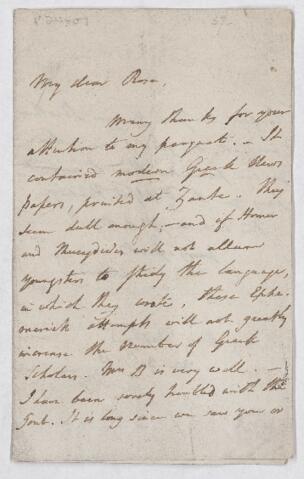
Holograph letter from Charles Burney Jr. addressed to W.F. Rose Esq. Navy Pay Office, London. Postmarked on final leaf with ink stamp: NO 30 1813. At end of letter: Rectory House, Deptford No. 30th 1813. Written in a sloping hand in brown ink and with a small repair to upper outer corner of final leaf of letter. The letter discusses some Greek newspapers sent along in a packet to Rose, Burney's latest struggles with gout, as well as potential future visitors to the Rectory. Letter is accompanied by a printed pamphlet.
Purchased from Spike Hughes Rare Books, March 2021.
English
Item also described in the McGill Library Catalogue.
The letter's addressee, William F. Rose, was Burney's nephew by marriage.
Letter is accompanied by the printed pamphlet: An Act for repealing so much of the Act of the twelfth and thirteenth years of the reign of King William the third, intituled, An Act for the farther limitation of the Crown : and better securing the rights and liberties of the subjects, as enacts that no person, who should come to the possession of the Crown, shall go out of the dominions of England, Scotland or Ireland, without consent of Parliament. London : Printed by John Baskett, and by the assigns of Thomas Newcomb, and Henry Hills, deceas'd, 1716.