File 113 - Leonard Woolf

Open original Digital object

Title and statement of responsibility area

Title proper

Leonard Woolf

General material designation

    Parallel title

    Other title information

    Title statements of responsibility

    Title notes

    • Source of title proper: Title based on contents.

    Level of description

    File

    Reference code

    CA RBD MS 951-1-113

    Edition area

    Edition statement

    Edition statement of responsibility

    Class of material specific details area

    Statement of scale (cartographic)

    Statement of projection (cartographic)

    Statement of coordinates (cartographic)

    Statement of scale (architectural)

    Issuing jurisdiction and denomination (philatelic)

    Dates of creation area

    Date(s)

    • 14 January 1917 - 3 October 1918 (Creation)
      Creator
      Woolf, Leonard, 1880-1969
      Place
      Richmond (London, England)

    Physical description area

    Physical description

    2 letters

    Publisher's series area

    Title proper of publisher's series

    Parallel titles of publisher's series

    Other title information of publisher's series

    Statement of responsibility relating to publisher's series

    Numbering within publisher's series

    Note on publisher's series

    Archival description area

    Name of creator

    (1880-1969)

    Biographical history

    Leonard Woolf was born on November 25, 1880, in London, England.

    He was a British essayist, author, political activist, and publisher. He was educated at St. Paul's School (1894-1899) and Trinity College, Cambridge (B.A., 1902), where he was elected to the Cambridge Apostles. He joined the civil service in 1904 and spent seven years in Ceylon, an experience that deeply influenced not only his political views but also his fictional writing. With his wife, the novelist Virginia Woolf, he began the Hogarth Press, a vanguard publishing house of the period. They both became influential in the Bloomsbury Group, and, in 1917, Woolf co-founded the 1917 Club. He became editor of the International Review (1919), the international section of the Contemporary Review (1920-1922), The Nation (later The New Statesman), and Athenaeum (1923-1930). He also co-founded and edited The Political Quarterly (1931-1959). Woolf was a committed socialist and member of the Fabian Society and Labour Party and served as a secretary for the Labour Party’s advisory committees on international and imperial affairs (1919-1945). An expert on international affairs, he wrote numerous volumes of political analysis. He was a founding member of the League of Nations Society. Woolf received an honorary doctorate from the University of Sussex in 1964. In 1965, he was elected a Fellow of the Royal Society of Literature. The Hogarth Press’ first publication, “Two Stories”, comprised his “Three Jews” and Virginia Woolf’s “The Mark on the Wall”. He wrote five volumes of autobiography, “Sowing” (1960), “Growing” (1961), “Beginning Again” (1964), “Downhill All the Way” (1967), and “The Journey Not the Arrival Matters” (1969). His late loving relationship with the artist Marjorie Tulip (Trekkie) Parsons (1902–1996) was revealed in their published letters.

    In 1912, he married the writer Adeline Virginia Stephen (1882–1941). He died on August 14, 1969, in Rodmell, England.

    Custodial history

    Scope and content

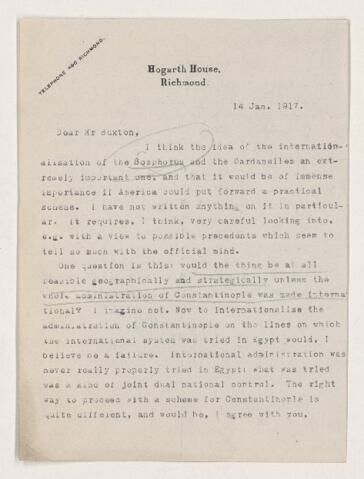
    Letters from Leonard Woolf to Buxton.

    Notes area

    Physical condition

    Immediate source of acquisition

    Arrangement

    Language of material

      Script of material

        Location of originals

        Availability of other formats

        Restrictions on access

        Terms governing use, reproduction, and publication

        Finding aids

        Associated materials

        Related materials

        Accruals

        Alternative identifier(s)

        Standard number

        Standard number

        Access points

        Subject access points

        Place access points

        Name access points

        Genre access points

        Control area

        Description record identifier

        Institution identifier

        Rules or conventions

        Status

        Level of detail

        Dates of creation, revision and deletion

        Language of description

          Script of description

            Sources

            Digital object (External URI) rights area

            Digital object (Reference) rights area

            Digital object (Thumbnail) rights area

            Accession area