
McGill Libraries
McLennan Library Building3459 rue McTavish
Montreal, Quebec
H3A 0C9
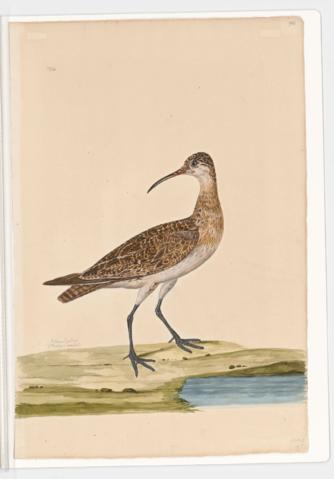
1 watercolour painting ; 56 x 39 cm + 1 leaf
Peter Paillou was born in London into a Huguenot family and was recognised in his own time as an eminent ‘bird painter’. In 1744 he began to paint for Taylor White and worked for him for almost thirty years, painting chiefly birds and mammals. He painted as well for Robert More, Joseph Banks, and for the Welsh naturalist Thomas Pennant. Many of his paintings of birds were used as the basis for book illustrations, often engraved by his colleague and fellow Huguenot, Peter Mazell. Paillou was elected to the Society of Artists and in 1763 he exhibited ‘A Piece of Birds, in Watercolours; the Hen of the Wood and Cock of the Red Game’. In 1778, to considerable approval, he also showed a picture of ‘A Horned Owl from Peru’, completely made from feathers.
Drawing of a possible Eskimo Curlew from a 18th century specimen [modern geographical distribution: believed to be extinct.] Attributed to Peter Paillou.
Unable to scan back of painting due to the fact that it is mounted on a board. .
Manuscript note on front of drawing: Least curlew (Phoepus minor)
No text on the Verso
Scientific name: Eskimo Curlew
With manuscript text on accompanying leaf.
Transcription of manuscript note on accompanying leaf: least Curlew
Bill is 2 1/2 upper Mandible Black under
m[an]dible partly red.
length from point of the Bill to the tail
15 inch & 1/2
The distance of the tips of the Wings when
open 25 inches. the Wings are longer then
the tail
the length of the legs from the top of ye thigh
to the end of the middle toe 6 inch 1/2
This Bird agrees in Colour with the
former except the Black dark lines, drawn from
the bill over the Eyes are wanting
& the Body of this is much less.
I know not whether this difers in sex
only or is a Diferent species.
Vol. 13 Page 46
Aves Grallae
Scolopax
Numenius minor
Phaeopus Minor.
Phaeopus S. rostro arcuato, pedibus Nigriscentibus
Teme femoribus semi nudis.
Novae. Superiore parte superiore corpore fusco.
marginibus plumarum palidis & in dorso & superiore
parte alarum seratis. parte inferiore palida
maculis tenuissimas fuscis notata.
habitat in Terra Nova.
The Small New foundland Curlew.
Its Bill hooked in length 3 inch & 1/2
the feet dark colloured allmost Black
the thighs are half naked as in most birds of this species
The length of the body from the Extremity of
from ye point of the Bill to the Tail is sixteen inches
The extent of the Wings when open 2 foot 6 inches
length of the legs 6 inch 3 gr.
The colour of the upper part of the Body
Dark brown each feather Edged with a pale or light
brown these edges in the feathers which cover the
Back are indented like a saw. The belly White.
This Bird with many others were brought me
from the North America by my learned friend
Hodgkinson Banks Esq
Translation of manuscript note on accompanying leaf: Aves Grallae
Scolopax
Numenius minor
Phaeopus Minor.
Phaeopus S. with a curved beak, black feet
Teme semi-bare thighs,
Novae. a body that is tawny on top,
with pale-edged and serrated feathers on the back and top parts of
the wings; and pale underparts marked
with very thin tawny patches.
It lives in Newfoundland.
The Small New foundland Curlew.
Its Bill hooked in length 3 inch & 1/2
the feet dark colloured allmost Black
the thighs are half naked as in most birds of this species
The length of the body from the Extremity of
from [the] point of the Bill to the Tail is sixteen inches
The extent of the Wings when open 2 foot 6 inches
length of the legs 6 inch 3 gr.
The colour of the upper part of the Body
Dark brown each feather Edged with a pale or light
brown these edges in the feathers which cover the
Back are indented like a saw. The belly White.
This Bird with many others were brought me
from the North America by my learned friend
Hodgkinson Banks Esq