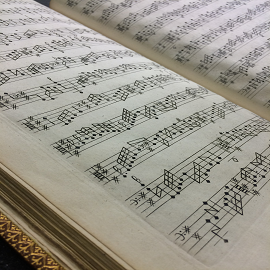
Item 1062 - Joy to the world

Title and statement of responsibility area

Title proper

Joy to the world

General material designation

    Parallel title

    Other title information

    Song with guitar chord diagrams and piano accompaniment

    Title statements of responsibility

    Title notes

    Level of description

    Item

    Reference code

    CA MDML 015-2-1062

    Edition area

    Edition statement

    Edition statement of responsibility

    Class of material specific details area

    Statement of scale (cartographic)

    Statement of projection (cartographic)

    Statement of coordinates (cartographic)

    Statement of scale (architectural)

    Issuing jurisdiction and denomination (philatelic)

    Dates of creation area

    Date(s)

    Physical description area

    Physical description

    Publisher's series area

    Title proper of publisher's series

    Parallel titles of publisher's series

    Other title information of publisher's series

    Statement of responsibility relating to publisher's series

    Numbering within publisher's series

    Note on publisher's series

    Archival description area

    Name of creator

    (1938-1999)

    Biographical history

    Folk music singer-songwriter Hoyt Axton, with a distinctive bass-baritone, was the son of a football-coach father and song writing English-teacher mother, Mae Boron Axton (she co-wrote Elvis Presley’s 1956 first hit, Heartbreak Hotel). He was born in Duncan, Oklahoma, but the family soon moved to Comanche in the same state; then in 1949 it went to Jacksonville, Florida, where Hoyt’s father, now a naval officer on the U.S.S. Princeton, was stationed. He got a football scholarship at Oklahoma State University and had been considering an athletic career, but left early and enlisted in the Navy instead. After discharge from the Navy, he headed west and began singing in San Francisco nightclubs; he had studied piano as a teen, later switching to guitar. He recorded his first album in the early 60s and many more during the 70s; he also sang and composed commercials and began making TV and film appearances. In 1978 he formed his own record label, Jeremiah, which did not last. He struggled with alcohol and cocaine addiction (noted in several of his songs), and had several unsuccessful marriages. Despite this busy career, his most notable successes were songs he wrote that others made famous; these included the Kingston Trio’s rendition of his song “Greenback Dollar” (1963) and Three Dog Night’s performance of his “Joy to the World” that topped the charts for 6 weeks, the top hit of 1971. Dozens of artists covered his songs over the next decades: Steppenwolf, Ringo Starr, Joan Baez, Arlo Guthrie, John Denver, Anne Murray. It was this legacy of song writing rather than his 45 film and movie appearances, or his own singing, that will be remembered. He was confined to a wheelchair after a stroke in 1995, and he and his fourth wife were arrested in 1997 for marijuana possession. In 1999, poor health led to two heart attacks, the second of which he did not survive. Both he and his mother were posthumously inducted into the Oklahoma Music Hall of Fame in Muskogee in 2007.

    Custodial history

    Scope and content

    Notes area

    Physical condition

    Immediate source of acquisition

    Arrangement

    Language of material

      Script of material

        Location of originals

        Availability of other formats

        Restrictions on access

        Terms governing use, reproduction, and publication

        Finding aids

        Associated materials

        Related materials

        Accruals

        Alternative identifier(s)

        Accession no.

        D1062

        Standard number

        Standard number

        Access points

        Subject access points

        Place access points

        Name access points

        Genre access points

        Control area

        Description record identifier

        Institution identifier

        Rules or conventions

        Status

        Level of detail

        Dates of creation, revision and deletion

        Language of description

          Script of description

            Sources

            Accession area