Item 349 - Indian Scops-Owl

Open original Digital object

Title and statement of responsibility area

Title proper

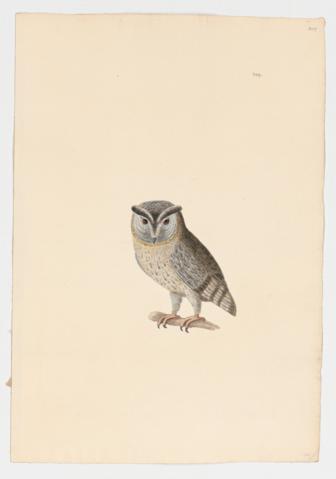
Indian Scops-Owl

General material designation

    Parallel title

    Other title information

    Otus bakkamoena

    Title statements of responsibility

    Title notes

    • Source of title proper: Title based on 2019 species identification.

    Level of description

    Item

    Reference code

    CA RBD MSG BW002-349

    Edition area

    Edition statement

    Edition statement of responsibility

    Class of material specific details area

    Statement of scale (cartographic)

    Statement of projection (cartographic)

    Statement of coordinates (cartographic)

    Statement of scale (architectural)

    Issuing jurisdiction and denomination (philatelic)

    Dates of creation area

    Date(s)

    • undated (Creation)
      Creator
      Paillou, Peter, approximately 1720-approximately 1790

    Physical description area

    Physical description

    1 watercolour painting ; 56 x 39 cm

    Publisher's series area

    Title proper of publisher's series

    Parallel titles of publisher's series

    Other title information of publisher's series

    Statement of responsibility relating to publisher's series

    Numbering within publisher's series

    Note on publisher's series

    Archival description area

    Name of creator

    (approximately 1720-approximately 1790)

    Biographical history

    Peter Paillou was born in London into a Huguenot family and was recognised in his own time as an eminent ‘bird painter’. In 1744 he began to paint for Taylor White and worked for him for almost thirty years, painting chiefly birds and mammals. He painted as well for Robert More, Joseph Banks, and for the Welsh naturalist Thomas Pennant. Many of his paintings of birds were used as the basis for book illustrations, often engraved by his colleague and fellow Huguenot, Peter Mazell. Paillou was elected to the Society of Artists and in 1763 he exhibited ‘A Piece of Birds, in Watercolours; the Hen of the Wood and Cock of the Red Game’. In 1778, to considerable approval, he also showed a picture of ‘A Horned Owl from Peru’, completely made from feathers.

    Custodial history

    Scope and content

    Drawing of an Indian Scops-Owl from a 18th century specimen [modern geographical distribution: India and Southeast Asia.] Attributed to Peter Paillou.

    Notes area

    Physical condition

    Immediate source of acquisition

    Arrangement

    Language of material

      Script of material

        Location of originals

        Availability of other formats

        Restrictions on access

        Terms governing use, reproduction, and publication

        Finding aids

        Associated materials

        Related materials

        Accruals

        General note

        Scientific name: Otus bakkamoena

        Accompanying material

        Transcription of manuscript note on accompanying leaf: Superciliosa
        Strix capite auriculato, corpore
        supra cinerascente supra subtus
        pallido, alis fasciis tribus fuscis.
        Magnituda sto. passerina seu coturnicis.
        Capitis anterior pars seu facies albida; Vertex
        cinereum. Auricula cinerascentes.
        Dorsum fusco-cinerascens, maculis
        Abdomen pallide flavescens. Alae
        pallida fasciis tribus fuscis apiceq[ue]
        fusco. Pedes pallidae. Cauda brevis
        Obs. Tota maculis longitudinalibus
        subsagittatis irrorata.
        Habitat in Zeylone.

        Accompanying material

        Translation of manuscript note on accompanying leaf: Superciliosa
        Strix with an eared head, a body that is
        ash-coloured on top and pale
        underneath, and wings with three tawny bands.
        It is the size of the sto. passerina [sparrow] or coturnicis [quail].
        The inner part of the head or the face is white; The crown
        is ash-coloured. The ears are ash-coloured.
        The back is tawny-ash-coloured,
        the abdomen is a pale golden-yellow. The wings
        are pale with three tawny bands and a tawny tip.
        The feet are pale. The tail is short.
        Obs[ervation]. It is completely speckled with
        arrow-like shaped spots running lengthwise.
        It lives in Ceylon.

        Alternative identifier(s)

        Volume number

        Birds Volume 3, Painting 11

        Standard number

        Standard number

        Access points

        Subject access points

        Place access points

        Name access points

        Genre access points

        Control area

        Description record identifier

        Institution identifier

        Rules or conventions

        Status

        Level of detail

        Dates of creation, revision and deletion

        Language of description

          Script of description

            Sources

            Digital object (External URI) rights area

            Digital object (Reference) rights area

            Digital object (Thumbnail) rights area

            Accession area