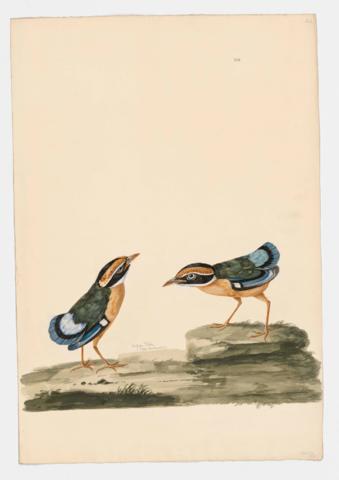
Item 522 - Indian Pitta

Open original Digital object

Title and statement of responsibility area

Title proper

Indian Pitta

General material designation

    Parallel title

    Indian Pitta

    Other title information

    Pitta brachyura

    Title statements of responsibility

    Title notes

    • Source of title proper: Caption title.
    • Parallel titles and other title information: Title from Mousley: Pitta brachyura

    Level of description

    Item

    Reference code

    CA RBD MSG BW002-522

    Edition area

    Edition statement

    Edition statement of responsibility

    Class of material specific details area

    Statement of scale (cartographic)

    Statement of projection (cartographic)

    Statement of coordinates (cartographic)

    Statement of scale (architectural)

    Issuing jurisdiction and denomination (philatelic)

    Dates of creation area

    Date(s)

    • undated (Creation)
      Creator
      Paillou, Peter, approximately 1720-approximately 1790

    Physical description area

    Physical description

    1 watercolour painting ; 56 x 39 cm + 1 leaf

    Publisher's series area

    Title proper of publisher's series

    Parallel titles of publisher's series

    Other title information of publisher's series

    Statement of responsibility relating to publisher's series

    Numbering within publisher's series

    Note on publisher's series

    Archival description area

    Name of creator

    (approximately 1720-approximately 1790)

    Biographical history

    Peter Paillou was born in London into a Huguenot family and was recognised in his own time as an eminent ‘bird painter’. In 1744 he began to paint for Taylor White and worked for him for almost thirty years, painting chiefly birds and mammals. He painted as well for Robert More, Joseph Banks, and for the Welsh naturalist Thomas Pennant. Many of his paintings of birds were used as the basis for book illustrations, often engraved by his colleague and fellow Huguenot, Peter Mazell. Paillou was elected to the Society of Artists and in 1763 he exhibited ‘A Piece of Birds, in Watercolours; the Hen of the Wood and Cock of the Red Game’. In 1778, to considerable approval, he also showed a picture of ‘A Horned Owl from Peru’, completely made from feathers.

    Custodial history

    Scope and content

    Drawing of a pair of Indian Pittas from 18th century specimens [modern geographical distribution: India.] Attributed to Peter Paillou.

    Notes area

    Physical condition

    Immediate source of acquisition

    Arrangement

    Language of material

      Script of material

        Location of originals

        Availability of other formats

        Restrictions on access

        Terms governing use, reproduction, and publication

        Finding aids

        Associated materials

        Related materials

        Accruals

        General note

        Manuscript note on front of drawing: Indian Pitta (Pitta brachyura)

        General note

        General note

        Scientific name: Pitta brachyura

        Accompanying material

        With manuscript text on accompanying leaf.

        Accompanying material

        Transcription of manuscript note on accompanying leaf: Ornatus
        Rallus luteus, dorso viridi,
        capite vittis tribus nigris,
        remigibus rectricibusque caeruleis.
        Magnitudo Alcedinis Ispido.
        Rostrum luteum. Caput luteum, supra
        vitta nigra notatum, ad later in utroq[ue]
        latere vitta lata nigra albo circum-
        scripta. Pectus & abdomen lutea.
        Dorsum viride. Urhopygium [uropigium] caeruleum.
        Alae nigrae, macula magna alba: remi-
        gibus caeruleis. Cauda rotundata
        caerulea, fascia nigris. Pedes lutei.

        Accompanying material

        Translation of manuscript note on accompanying leaf: Ornatus
        Rallus luteus [The ornate yellow Rail], with a green back,
        three black bands on the head,
        and blue flight feathers on the wings and tail.
        It is the size of the Alcedinis Ispido [the kingfisher].
        The beak is yellow. The head is yellow, and marked
        with a black band on the top; on either
        side [of the head] there is a wide black band with a white line
        around it. The breast and abdomen are yellow.
        The back is green. The rump is blue.
        The wings are black, with a large white patch: the flight
        feathers are blue. The tail is rounded
        and blue, with black bands. The feet are yellow.

        Alternative identifier(s)

        Volume number

        Birds Volume 7, Painting 19

        Standard number

        Standard number

        Access points

        Subject access points

        Place access points

        Name access points

        Genre access points

        Control area

        Description record identifier

        Institution identifier

        Rules or conventions

        Status

        Level of detail

        Dates of creation, revision and deletion

        Language of description

          Script of description

            Sources

            Digital object (External URI) rights area

            Digital object (Reference) rights area

            Digital object (Thumbnail) rights area

            Accession area