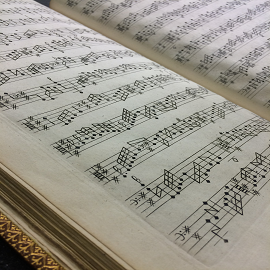
Item 045 - Hooray for love, from the film Casbah

Title and statement of responsibility area

Title proper

Hooray for love, from the film Casbah

General material designation

    Parallel title

    Other title information

    Song with piano accompaniment

    Title statements of responsibility

    Title notes

    Level of description

    Item

    Reference code

    CA MDML 015-2-045

    Edition area

    Edition statement

    Edition statement of responsibility

    Class of material specific details area

    Statement of scale (cartographic)

    Statement of projection (cartographic)

    Statement of coordinates (cartographic)

    Statement of scale (architectural)

    Issuing jurisdiction and denomination (philatelic)

    Dates of creation area

    Date(s)

    Physical description area

    Physical description

    Publisher's series area

    Title proper of publisher's series

    Parallel titles of publisher's series

    Other title information of publisher's series

    Statement of responsibility relating to publisher's series

    Numbering within publisher's series

    Note on publisher's series

    Archival description area

    Name of creator

    (1905-1986)

    Biographical history

    Born Hyman Arluck in Buffalo, New York, the child of a Jewish cantor, he learned to play the piano as a youth, and formed a band as a young man. He achieved local success as a pianist and singer before moving to New York City in his early twenties, where he worked as an accompanist in vaudeville and changed his name to Harold Arlen. Between 1926 and about 1934, Arlen appeared occasionally as a band vocalist on records by artists, among others Eddie Duchin.

    In 1929, Arlen composed his first well-known song: "Get Happy" (with lyrics by Ted Koehler). Throughout the early and mid-1930s, Arlen and Koehler wrote shows for the Cotton Club, a popular Harlem night club, as well as for Broadway musicals and Hollywood films. Arlen and Koehler's partnership resulted in a number of hit songs, including the familiar standards like "Stormy Weather.”

    In the mid-1930s, Arlen married, and spent increasing time in California, writing for movie musicals. He began working with lyricist E. Y. "Yip" Harburg and in 1938, the team was hired by MGM to compose songs for The Wizard of Oz, the most famous of which is "Over the Rainbow", for which they won the Academy Award for Best Music, Original Song. He also wrote "The Man That Got Away”, both defining songs of Judy Garland's career.

    In the 1940s, Arlen teamed up with lyricist Johnny Mercer, and continued to write hit songs like "That Old Black Magic", "Ac-Cent-Tchu-Ate the Positive", and "One for My Baby (and One More for the Road)."

    Arlen died in 1986 of cancer at his Manhattan apartment at the age of eighty-one. Shortly before his death, Arlen adopted the 22 year old adult son of his brother Julius "Jerry" Arluck, so that his estate would have an heir in order to extend his copyright. Samuel Arlen runs the company that owns the rights to the Arlen catalog.

    Custodial history

    Scope and content

    Notes area

    Physical condition

    Immediate source of acquisition

    Arrangement

    Language of material

      Script of material

        Location of originals

        Availability of other formats

        Restrictions on access

        Terms governing use, reproduction, and publication

        Finding aids

        Associated materials

        Related materials

        Accruals

        Alternative identifier(s)

        Accession no.

        D45

        Standard number

        Standard number

        Access points

        Subject access points

        Place access points

        Name access points

        Genre access points

        Control area

        Description record identifier

        Institution identifier

        Rules or conventions

        Status

        Level of detail

        Dates of creation, revision and deletion

        Language of description

          Script of description

            Sources

            Accession area