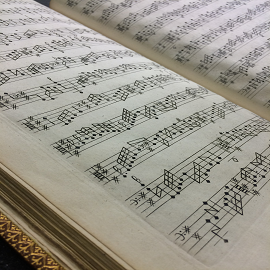
Item 985 - Cantique de Noël (Christmas song)

Title and statement of responsibility area

Title proper

Cantique de Noël (Christmas song)

General material designation

    Parallel title

    Other title information

    Song with piano accompaniment

    Title statements of responsibility

    Title notes

    Level of description

    Item

    Reference code

    CA MDML 015-2-985

    Edition area

    Edition statement

    Edition statement of responsibility

    Class of material specific details area

    Statement of scale (cartographic)

    Statement of projection (cartographic)

    Statement of coordinates (cartographic)

    Statement of scale (architectural)

    Issuing jurisdiction and denomination (philatelic)

    Dates of creation area

    Date(s)

    Physical description area

    Physical description

    Publisher's series area

    Title proper of publisher's series

    Parallel titles of publisher's series

    Other title information of publisher's series

    Statement of responsibility relating to publisher's series

    Numbering within publisher's series

    Note on publisher's series

    Archival description area

    Name of creator

    (1803-1856)

    Biographical history

    Parisian-born French composer Adolphe Charles Adam was the son of Alsatian composer and pianist Johann Ludwig (Jean-Louis) Adam. The latter opposed Adolphe’s musical inclinations, but young Adolphe liked to improvise and was secretive about his composing. At the age of 17 he was allowed to attend the Paris Conservatoire after he promised that his musical interests were only for his own amusement, not for a career. He studied organ and harmonium there under François Adrien Boieldieu but did not keep his promise to his father. By 1830 he had completed 28 works for the theater. To escape the political turmoil in Paris, he went to London for a couple of years. On his return in 1832, he composed more operas, the most popular of which was the 1834 comic operetta “Le Chalet,” a joint effort with his friend, librettist Eugene Scribe. His career was assured with another success, “Le postillon de Longjumeau.” After some differences with the Opéra de Paris, in 1847 he decided to open another opera house in Paris, the Théâtre National. The revolutionary political situation in 1848 meant that it was forced to close, causing him to lose both his own investment and the loans he had undertaken. After his father’s death and heavily in debt, he took a position teaching at the Conservatoire in 1849, where ballet composer Léo Delibes was among his pupils. He worked there until he died in his sleep in 1856. In the course of his prolific career he wrote 70 operas and 14 ballets, the best known of which are Giselle (1841) and Le Corsaire (1856). Although Giselle was not particularly popular at the time, after its revival by famous Russian dancer Sergei Diaghilev in 1910, it became one of the most sought-after roles for ballerinas. He also wrote the Christmas carol “O Holy Night,” known in French as “Minuit, Chrétiennes” or “Cantique de Noël.” Played on the violin by Canadian inventor, Reginald Fessenden, on Christmas Eve in 1906, it was the first piece of music ever broadcast on radio.

    Custodial history

    Scope and content

    Notes area

    Physical condition

    Immediate source of acquisition

    Arrangement

    Language of material

      Script of material

        Location of originals

        Availability of other formats

        Restrictions on access

        Terms governing use, reproduction, and publication

        Finding aids

        Associated materials

        Related materials

        Accruals

        General note

        Two copies. Lyrics in French and English in copy one. Copy two has lyrics in English, French, Italian and Latin and a violin part.

        Alternative identifier(s)

        Accession no.

        D985

        Standard number

        Standard number

        Access points

        Subject access points

        Place access points

        Name access points

        Genre access points

        Control area

        Description record identifier

        Institution identifier

        Rules or conventions

        Status

        Level of detail

        Dates of creation, revision and deletion

        Language of description

          Script of description

            Sources

            Accession area