
Caesarea (Israel)

Elements area

Taxonomy

Code

Scope note(s)

    Source note(s)

      Display note(s)

        Hierarchical terms

        Caesarea (Israel)

          Equivalent terms

          Caesarea (Israel)

            Associated terms

            Caesarea (Israel)

              3 Archival description results for Caesarea (Israel)

              3 results directly related Exclude narrower terms
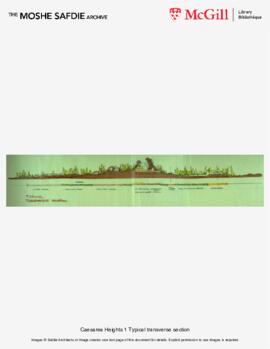
              Caesarea Heights
              CA CAC 58-1-10005 · Subseries · between 1973 and 1976
              Part of Moshe Safdie

              Caesarea Heights was an urban planning proposal for a site in Caesarea, a city positioned between Tel Aviv and Haifa. The proposed development consisted of 1,700 housing units overlooking the Caesarea Golf Course and the sea, including a variety of housing types constructed at different densities, designed to accommodate a broad range of family sizes and needs.

              Clusters and individual units were designed to be particularly sensitive to orientation, and attempted to maximize views for all residents. Green spaces were integrated to separate major roads from residences, and to also provide a degree of privacy between clusters of housing. In general, the concept of "small communities" or clusters was emphasized, which is in keeping with the character of the Israeli lifestyle.

              Safdie Architects
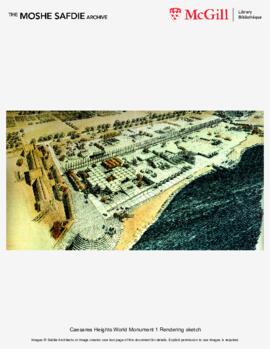
              CA CAC 58-1-286 · Subseries · 1979
              Part of Moshe Safdie

              The Caesarea World Monument involved building a World Study Center with the development of a master plan to restore and reconstruct the ancient city of Caesarea Maritima on the Sea. The entire project was divided into six phases, and Safdie's involvement was limited to the first two phases: the restoration of the Cardo Maximus, a 0.4 km pedestrian walkway extending from the amphitheatre to the moat of the Crusader Fortress; and the construction of the World Study Center Building, providing facilities for archaeological research and study, as well as for preservation and display of excavated material.

              Safdie Architects