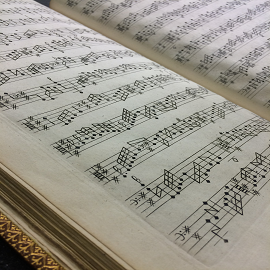
Item 593 - Amour je te dois...

Title and statement of responsibility area

Title proper

Amour je te dois...

General material designation

    Parallel title

    Other title information

    Song with piano accompaniment

    Title statements of responsibility

    Title notes

    Level of description

    Item

    Reference code

    CA MDML 015-2-593

    Edition area

    Edition statement

    Edition statement of responsibility

    Class of material specific details area

    Statement of scale (cartographic)

    Statement of projection (cartographic)

    Statement of coordinates (cartographic)

    Statement of scale (architectural)

    Issuing jurisdiction and denomination (philatelic)

    Dates of creation area

    Date(s)

    Physical description area

    Physical description

    Publisher's series area

    Title proper of publisher's series

    Parallel titles of publisher's series

    Other title information of publisher's series

    Statement of responsibility relating to publisher's series

    Numbering within publisher's series

    Note on publisher's series

    Archival description area

    Name of creator

    (1909-1971)

    Biographical history

    Pierre Dorsey (born Pierre Gustave Dreyfus, pseudonym Ricardo Rodilo) was born in Orsay, Essonne, France. Not much is known about his younger years and education. Under his birth name he co-wrote with Raymond Asso the song “Le mauvais matelot,” sung by Edith Piaf around 1937. There is a record of him, accompanied by his mother and father( and possibly his wife), arriving in Brazil in 1955. His songs “Je te tendrai les bras” (co-written with Hubert Giraud) and “Amour, je te dois” (co-written with Robert Gall), both of which were written under his professional name, Pierre Dorsey, won the 1959 and 1960 Coq d’or de la chanson française competition. The next we hear is that the third-place entry in the Eurovision competition was won by the song “Ce soir-là,” which he co-wrote with Hubert Giraud, sung by French singer François Deguelt, on behalf of Monaco. From then on, he seems to have had many successes playing the piano with his string orchestra and later in a trio that included his son. He composed and wrote lyrics prolifically: the Bibliothèque national de France has 97 entries for him, including songs covered by various artists, and Encyclopédisque lists 19 entries. Most of his songs were released in Europe.

    Custodial history

    Scope and content

    Notes area

    Physical condition

    Immediate source of acquisition

    Arrangement

    Language of material

      Script of material

        Location of originals

        Availability of other formats

        Restrictions on access

        Terms governing use, reproduction, and publication

        Finding aids

        Associated materials

        Related materials

        Accruals

        Alternative identifier(s)

        Accession no.

        D593

        Standard number

        Standard number

        Access points

        Subject access points

        Place access points

        Name access points

        Genre access points

        Control area

        Description record identifier

        Institution identifier

        Rules or conventions

        Status

        Level of detail

        Dates of creation, revision and deletion

        Language of description

          Script of description

            Sources

            Accession area