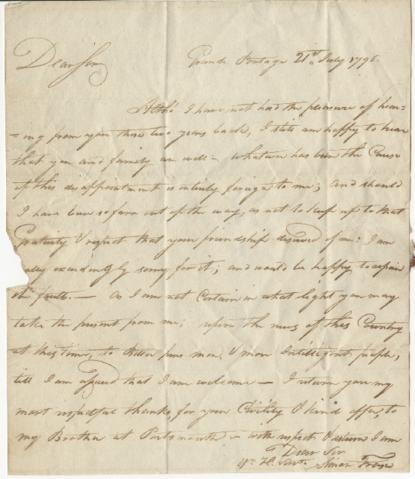
Item 14 - Letter from Simon Fraser to Simon McTavish, 21 July 1796

Open original Digital object

Title and statement of responsibility area

Title proper

Letter from Simon Fraser to Simon McTavish, 21 July 1796

General material designation

    Parallel title

    Other title information

    Title statements of responsibility

    Title notes

    • Source of title proper: Title based on contents of item.

    Level of description

    Item

    Reference code

    CA RBD MSG 431-14

    Edition area

    Edition statement

    Edition statement of responsibility

    Class of material specific details area

    Statement of scale (cartographic)

    Statement of projection (cartographic)

    Statement of coordinates (cartographic)

    Statement of scale (architectural)

    Issuing jurisdiction and denomination (philatelic)

    Dates of creation area

    Date(s)

    • 21 July 1796 (Creation)
      Creator
      Fraser, Simon, 1776-1862
      Place
      Grand Portage (Minn.)

    Physical description area

    Physical description

    1 folded sheet ; 22.2 cm x 18.9 cm

    Publisher's series area

    Title proper of publisher's series

    Parallel titles of publisher's series

    Other title information of publisher's series

    Statement of responsibility relating to publisher's series

    Numbering within publisher's series

    Note on publisher's series

    Archival description area

    Name of creator

    (1776-1862)

    Biographical history

    Simon Fraser was born in 1776 in Mapletown (near Bennington, Vermont) and died on his farm near St Andrews, Stormont County (Ontario). He was the eighth and youngest child of Simon Fraser and Isabella Grant. On June 7, 1820, Fraser married Catherine Macdonell and they had five sons and three daughters. In 1790, Fraser moved to Montreal with his family, and began an apprenticeship in the North West Company two years later. He served as a clerk in Athabasca in 1799 and became one of the company’s partners in 1802. In the autumn of 1805, Fraser built the Rocky Mountain Portage House at the end of the Peace River Canyon, after being instructed to extend fur trade operations west of the Rocky Mountains. He then built a small fort called Trout Lake Post (now known as Fort McLeod), which was the first permanent white settlement west of the Rockies. Fraser then went on to establish Fort Fraser and Fort George (now Prince George in British Columbia). He went on leave after these expeditions and then was assigned again to the Athabasca Department in 1810, where he remained until 1814. In 1815, Fraser travelled to Red River, where he became involved in a crisis between the North West Company and the Hudson’s Bay Company. He assisted other North West Company partners in escorting Miles Macdonell, governor of the colony, to Fort William that summer, and because of this, he was arrested by Lord Selkirk (1771-1820, Thomas Douglas, 5th Earl of Selkirk). He, along with other North West Company partners including Alexander McKenzie, John McDonald, John Siveright, and John McLoughlin were tried in York (Toronto) in October 1818 on charges relating to the violence in Red River. They were all acquitted and their trials are known as one of the most controversial series of trials in Canadian legal history. By this time, Fraser had settled on farm lands on the Raisin River, near St Andrews.

    Custodial history

    Scope and content

    Manuscript letter to McTavish signed Simon Fraser, dated Grande Portage 21st July 1796.

    Notes area

    Physical condition

    Immediate source of acquisition

    Arrangement

    Language of material

      Script of material

        Location of originals

        Availability of other formats

        Restrictions on access

        Terms governing use, reproduction, and publication

        Finding aids

        Generated finding aid

        Associated materials

        Related materials

        Accruals

        General note

        Remnants of a red wax seal.

        Alternative identifier(s)

        Standard number

        Standard number

        Access points

        Subject access points

        Place access points

        Name access points

        Genre access points

        Control area

        Description record identifier

        Institution identifier

        Rules or conventions

        Status

        Level of detail

        Dates of creation, revision and deletion

        Language of description

          Script of description

            Sources

            Digital object (External URI) rights area

            Digital object (Reference) rights area

            Digital object (Thumbnail) rights area

            Accession area