
- CA CAC 58-1-604
- Subseries
- 2005
Part of Moshe Safdie
Alaska State Capitol, Juneau, Alaska, United States of America.
Safdie Architects


Part of Moshe Safdie
Alaska State Capitol, Juneau, Alaska, United States of America.
Safdie Architects
Part of Moshe Safdie
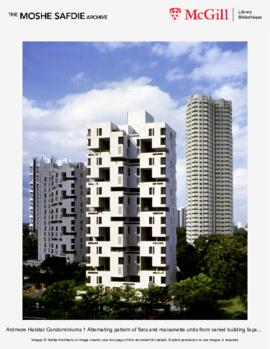
The Ardmore Habitat Condominiums are situated in the heart of downtown Singapore, adjacent to the famed Orchard Road. The project consists of two 17-story towers of vertically stacked terraced units. The project was constructed by Robin Loh Enterprises, shipbuilders and developers, with the objective of providing the amenities of Habitat '67 to a constricted downtown site zoned for vertical massing.
Both towers consist of alternating flat and two-story apartments, opening to a large outdoor garden. The two-story maisonettes are organized around an atrium, which extends to a large double-height external garden that serves as a visual and physical extension of the living area.
Sizeable roof terraces extend the living area of each unit, strengthening the vertical and horizontal spatial experience. On the exterior this interplay manifests as an alternating pattern of flats and maisonette units, creating a multidirectional façade. Terraces wrap the corners of the towers, further articulating the elements of solid and void.
The towers contain 61 middle income and luxury housing units, which are connected at ground level by landscaped recreation areas that include a swimming pool, squash courts, and gardens.
Safdie Architects

AT&T Center for the Performing Arts
Part of Moshe Safdie
The Pantages Place development sought to create a landmark in the heart of Toronto. The proposed development was a mixed-use commercial and residential building including the AT&T Centre for the Performing Arts, comprised of the 2200-seat Pantages Theatre and a new 1400-seat theatre and Pantages Tower, a high-rise that contained a hotel and condominiums.
The initial phase of the development was to contain 5 levels of belowgrade parking, an expansion to the exisitng Pantages Theatre stage, a new, 1400-seat theatre, the tower core to the 9th floor, street related retail, a residential lobby and a hotel lobby.
The second phase was to include a 41-storey, 419 foot tower combining up-scale condominiums and a four-start hotel. The 313-room hotel was to be located in the lower 25 levels of the building, while the 192 condominium units occupied the upper 16 floors. The structure was to consist of a structural concrete frame clad with precast concrete panels with fenestration and a glazed curtainwall.
The project was projected to be completed by 2000.
Safdie Architects

Part of Moshe Safdie
The name of this project was derived from its location, adjacent to a "plaza" shopping center outside of downtown Kansas City, and the design of the units which have as their focal point a two-story, 200 square foot glass enclosed atrium. The project is composed of forty luxury condominium units positioned on a steeply sloped site. Because of the slope, uphill units will have spectacular views over the roofs of the buildings below. In addition, the slope helps to enclose internal gardens and outdoor terraces which open directly from the atrium to afford more privacy for its residents. The highlighted enclosed atrium can be used as a green house or garden room extension of the living area, and also serves as a solar collector during the winter months. During the summer it is protected from overheating by a retractable exterior shade.
Safdie Architects
Part of Moshe Safdie
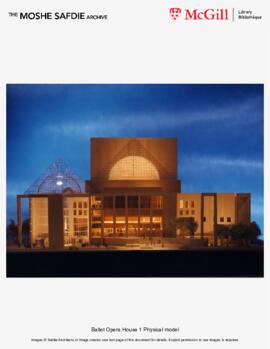
The Ballet Opera House was planned as the home and performance center for the National Ballet of Canada and the Canadian Opera Company, located in downtown Toronto between Bay and Yonge Streets. When a new provincial government was elected, however, the project was indefinitely shelved pending resolution of funding issues. Safdie's design features a public passage, referred to as "Gallery of the Artists," traversing the site at street level and accommodating specialty retail elements. The heart of the project was to be a 2,000 seat auditorium consisting of a main stage and three support stages, while the exterior of the building was to be composed of a series of tower-like elements that integrated it with the surrounding streets of Toronto.
Safdie Architects
Part of Moshe Safdie
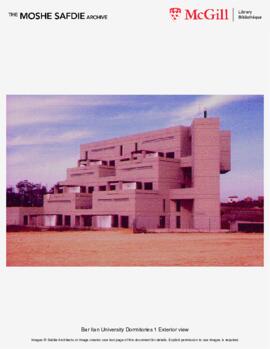
The Bar Ilan University master plan that Moshe Safdie designed was for the School of Economics and the Student Dormitories. It was planned as an urban system composed of open quadrangles defined by buildings and urban thorough fares which branched out to secondary roads and other squares. The School of Economics is an 8-storey multi-purpose building that is terraced, providing shade for the main campus walkway by its overhangs. The Student Dormitories, accommodating about 200 students, consist of a 2-storey living area around which the bedrooms are clustered. Overall, the dorms reach 6 storeys in height, stacking three terraced apartment units together, with the public spaces facing the academic quadrangle and the private spaces facing the south.
Safdie Architects
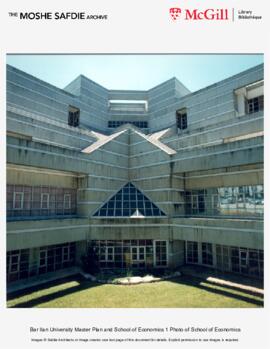
Bar Ilan University Master Plan
Part of Moshe Safdie
The new Bar Ilan University master plan that Moshe Safdie designed was for the School of Economics and the Student Dormitories. It was planned as an urban system composed of open quadrangles defined by buildings and urban thorough fares which branched out to secondary roads and other squares. The School of Economics is an 8-storey multi-purpose building that is terraced, providing shade for the main campus walkway by its overhangs. The Student Dormitories, accommodating about 200 students, consist of a 2-storey living area around which the bedrooms are clustered. Overall, the dorms reach 6 storeys in height, stacking three terraced apartment units together, with the public spaces facing the academic quadrangle and the private spaces facing the south.
Safdie Architects
Part of Moshe Safdie
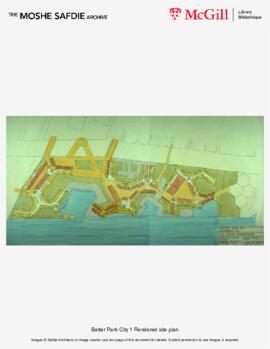
Located along the Hudson River not far from the former World Trade Center, the project was envisioned to solve the city's housing shortage. The master plan accommodated affordable housing for approximately 400,000 people. Safdie's proposal included 14,100 apartments, several schools, a library, a hospital, and other amenities covering 91 36.4 ha. The prefabricated modular construction system was also explored for this project.
Safdie Architects
Part of Moshe Safdie
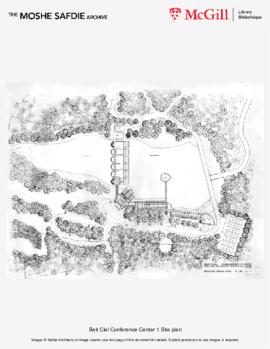
Moshe Safdie conceived the Beit Clal Conference Center as a building bridging the water. The site for the project was located in a naturally wooded area with a pond, formed from an existing stream in Pomona, New York. The overall complex was an "L-shape" with the north-south spine contoured along the pond's edge and the east-west spine spanning the pond as a bridge structure. The center was designed to serve as a "think-tank" - a meeting place for the exchange of knowledge in training and leadership for the Jewish community.
Safdie Architects